

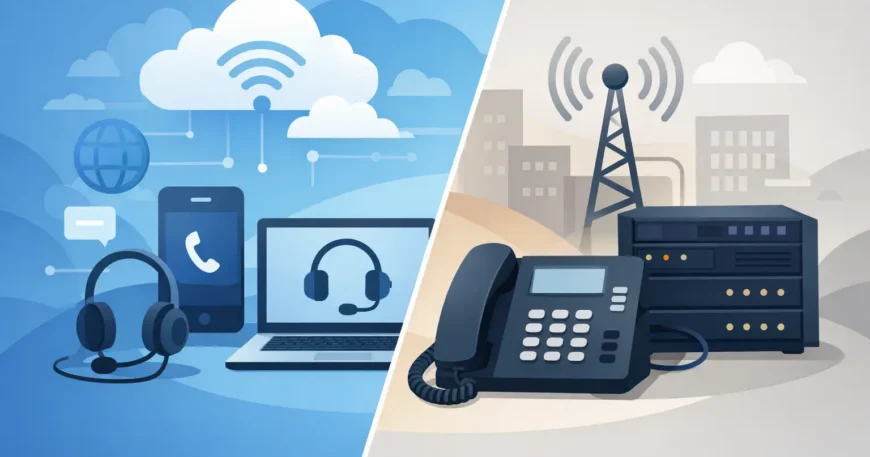
A phone system is only noticed when it fails: a customer reaches a dead line, a warehouse team misses a dispatch call, or a property office cannot contact a resident. The VoIP vs traditional phone systems decision is therefore less about choosing the newest technology and more about protecting everyday communication.
For offices, apartment properties, warehouses and homes, the right answer depends on the building, the existing cabling, internet reliability, call volume and how the system needs to grow. A properly planned phone installation can keep costs sensible while giving staff and residents the service they expect.
VoIP vs traditional phone systems: the core difference
Traditional phone systems use dedicated telephone wiring and a service supplied by a phone carrier. Older systems may use analogue lines, while larger business installations often use a private branch exchange, known as a PBX, connected to multiple phone lines. The call path is separate from the building’s data network.
VoIP, or Voice over Internet Protocol, converts voice into digital data and sends it across an internet connection. Desk handsets, conference phones, mobile apps and softphones can all connect to the same business phone service. Rather than relying on a separate phone line for every extension, the system uses the network infrastructure already serving computers, security cameras and other connected equipment.
That difference affects more than the monthly bill. It changes what needs to be installed, how calls are managed, how easily staff can work from another location, and what happens during an internet or power outage.
Where VoIP is usually the better fit
VoIP is often the practical choice for businesses that need flexibility without installing or maintaining a large on-site phone platform. New offices, refurbished suites and growing companies can add extensions, ring groups and call routing through a hosted service rather than buying significant PBX hardware.
For a business with staff split between an office, warehouse, home and job sites, VoIP can keep everyone under one main number. Calls can ring a desk phone and a mobile app at the same time, transfer between users, or route to another location after hours. Reception staff can see availability more clearly, while managers can adjust call flows as staffing changes.
VoIP also suits many multi-dwelling properties. A property manager may need office phones, gate or intercom connections, common-area paging and reliable internet infrastructure working together. With structured Cat6 cabling, correctly placed network switches and a properly designed connection to the provider, the property can support modern communications without extending outdated phone cabling throughout every upgraded area.
The appeal is not simply lower cost. Hosted VoIP can reduce the need for specialist on-site phone equipment and make moves, additions and changes far easier. For a business opening a second location, adding ten staff, or moving to a renovated floor, that can save real time and disruption.
VoIP depends on the network being right
VoIP call quality is only as good as the network carrying it. A fast internet plan alone does not guarantee clear calls. Network congestion, poor Wi-Fi coverage, undersized switches, incorrect cable termination and an overloaded connection can all cause choppy audio, delay or dropped calls.
A professional installation should assess bandwidth, cabling condition, switch capacity and traffic priorities. Voice traffic may need to be prioritised so a large file transfer, CCTV footage upload or guest Wi-Fi use does not interfere with an important customer call. Wired Ethernet connections are generally the dependable choice for fixed desk phones, particularly in busy offices and warehouse environments.
Power also matters. Traditional analogue lines have historically provided limited power from the carrier, allowing some basic corded phones to work during a local power failure. VoIP equipment needs power for the modem, router, switches and handsets. A battery backup or uninterruptible power supply can keep critical equipment operating through shorter outages, while call forwarding can send calls to nominated mobiles if the site goes offline.
When a traditional phone system still makes sense
Traditional does not automatically mean obsolete. In buildings with an existing, well-maintained phone system and stable calling needs, keeping the current arrangement can be sensible. A small site with a few lines, limited reliance on internet services and no plans for remote work may not gain enough from a full changeover to justify the immediate cost.
Some facilities also keep analogue or dedicated lines for specific equipment, such as older alarm panels, lift emergency phones, fax machines or legacy entry systems. Before removing any existing telephone service, each device should be identified and tested. Replacing a phone service without checking connected equipment can create an avoidable safety or compliance problem.
Traditional systems can also provide a useful fallback for organisations where calls must remain available during extended network or power interruptions. This does not mean every site needs two separate systems. It means the communication plan should reflect the risk. A medical practice, security desk, property management office or business handling urgent service calls may benefit from a backup line, cellular failover or well-configured call diversion.
The limitations of older phone infrastructure
The main drawback of a traditional setup is usually flexibility. Adding extensions can require carrier work and additional physical lines. Moving staff between rooms or locations may involve more cabling and reprogramming. Features such as mobile integration, call analytics, voicemail-to-email and flexible after-hours routing may be limited or add cost.
Older PBX systems can also become harder to maintain as parts and experienced support become less available. That does not require an immediate replacement, but it is a good reason to plan ahead rather than wait for a failure. A staged migration can allow a business to retain critical services while moving everyday calling to a more adaptable platform.
Cost is more than the monthly service charge
Comparing VoIP and traditional phone systems on monthly line rental alone can be misleading. The full cost includes installation, handsets, cabling, network upgrades, service fees, maintenance, provider charges and the time lost when a system does not perform properly.
VoIP may have lower recurring costs for businesses with multiple users and locations, especially where internet infrastructure is already in place. However, an older building may need new Cat5e or Cat6 runs, improved Wi-Fi, upgraded switches or a better internet connection before it can support dependable voice service. Those upgrades are an investment in the whole network, not just the phones.
Traditional services may appear straightforward where existing lines are present, but expenses can increase as lines are added or ageing equipment needs repair. If the system prevents staff from taking calls away from their desks or makes growth difficult, the operational cost may be higher than the invoice suggests.
The best approach is to price the complete requirement over several years. Include expected staff growth, building changes, remote work needs, support arrangements and the cost of downtime. That gives decision-makers a clearer basis than a headline price alone.
Cabling and design determine the outcome
Whether a site selects VoIP, traditional lines or a mixed arrangement, the physical installation still matters. Neat, labelled cabling makes troubleshooting faster and future changes less disruptive. Correctly terminated data outlets, organised racks, tested Ethernet runs and sensible equipment placement give the system a solid foundation.
For a new office or major refurbishment, it is often efficient to install structured cabling for both current and future requirements. A data outlet at each workstation can support a VoIP handset, computer or other networked device as needs change. In warehouses, distribution areas and large properties, planning coverage, cable routes and equipment locations before walls are closed or operations begin can prevent expensive rework.
Multi-dwelling and high-rise retrofit projects need extra planning. Internet delivery to each unit, backbone capacity, riser pathways, common-area equipment and future maintenance access all affect the result. A quick fix in one area can create a difficult service issue across the property later.
Questions to answer before choosing
Start with the practical requirements. How many people need a dedicated extension? Do calls need to ring on mobiles or at multiple sites? Are there legacy alarms, lifts, fax machines, intercoms or access systems connected to existing lines? What happens if the internet connection fails? And is the current cabling capable of supporting voice, data and security systems without congestion?
A site assessment can turn those questions into a clear plan. In some cases, VoIP is the obvious long-term choice. In others, retaining selected traditional lines while modernising the main phone system is the sensible option. Georgia Technical Services can assess the network, cabling and low-voltage requirements together, so the phone decision does not create problems elsewhere in the building.
The right phone system should let people answer calls confidently, adapt when the property changes and remain supportable when something goes wrong. Start with the infrastructure and the real work happening on site, then choose the technology that serves it properly.


Comments (2)
🔗 Transfer to you. GET >>> graph.org/BALANCE-36824-US-DOLLARS-04-24?hs=c8f55fa8039f051a32c52fcbea519148&
i1ausn
💰 Payment 169.97 USDT >> graph.org/BALANCE-3682444-USD-04-21-3?hs=c8f55fa8039f051a32c52fcbea519148& 💰
tg6i7o