

A warehouse manager needs clear footage at a loading dock before the next delivery arrives. An apartment owner wants to check common-area cameras from a mobile. A homeowner may simply want reliable coverage of the driveway. In each case, the analogue cameras vs IP surveillance decision affects more than the cameras themselves. It determines the cabling, recorder, network capacity, future upgrade options and the quality of evidence available when it matters.
Neither option is automatically right for every property. The best choice depends on the existing wiring, the number of cameras, the level of detail required and whether the system needs to grow over time.
Analogue Cameras vs IP Surveillance: The Core Difference
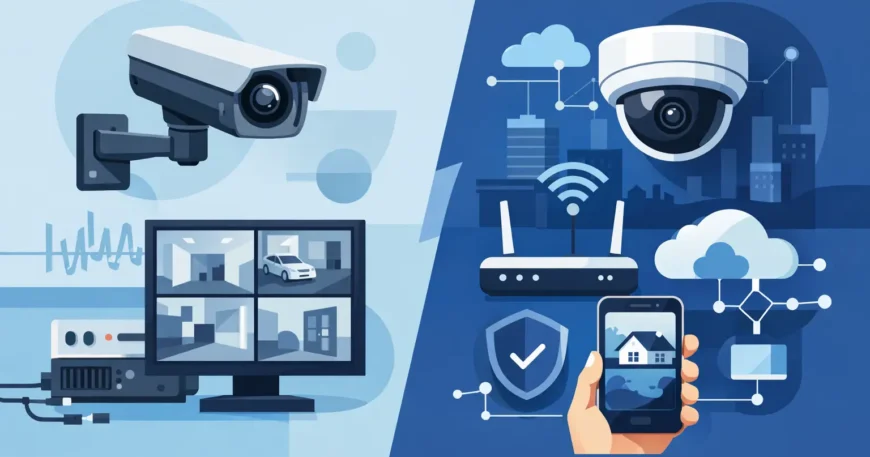
Traditional analogue camera systems send video over coaxial cable to a digital video recorder, usually called a DVR. Modern HD analogue cameras can produce far better images than older CCTV systems, often using existing RG59 or similar coax cabling. This makes them a practical upgrade where a property already has analogue runs in place.
IP cameras are network devices. Each camera sends digital video across Ethernet cabling to a network video recorder, or NVR, and in some cases to on-site or cloud-based storage. They commonly use Power over Ethernet, known as PoE, so one Cat5e or Cat6 cable provides both data and power.
That difference in architecture drives most of the real-world trade-offs. Analogue systems are generally simpler to install in an existing coax environment. IP systems offer stronger flexibility, higher resolution options and easier expansion when the network has been properly planned.
Image Quality Is About More Than Resolution
IP cameras are often the better fit where identification is critical. Higher-resolution models can capture faces, vehicle details and activity across a wider area without needing as many cameras. They also offer more options for digital zoom, analytics, line-crossing alerts and smart search functions.
However, more megapixels are not a guarantee of useful footage. A poorly positioned 4K IP camera can miss the same detail as a well-positioned 1080p analogue camera. Lighting, lens selection, mounting height, glare and night performance all matter. A camera aimed at a bright roller door or low afternoon sun needs a different approach from one monitoring a dim internal corridor.
Modern HD analogue cameras can still provide clear, usable video for entrances, driveways, hallways and smaller commercial sites. If the goal is dependable monitoring rather than advanced analytics or close-detail coverage across a large yard, analogue may be the more cost-effective option.
Cabling Usually Decides the Budget
For existing properties, cabling is often the largest practical consideration. If coaxial cable is already installed and in good condition, an HD analogue upgrade can avoid the disruption and expense of replacing every camera run. The existing cable can be tested, terminated correctly and connected to a compatible DVR.
IP surveillance is usually the stronger choice for new builds, major renovations, office fit-outs and properties already planning structured cabling. Cat6 cabling supports camera connectivity while leaving room for other network requirements. With PoE switches, cameras can receive power through the same cable, reducing the need for local power outlets at each mounting point.
Distance needs attention in both systems. Standard Ethernet runs have length limits, and larger sites may need fibre backbone links, additional network cabinets or PoE extenders. Warehouses, multi-building properties and multi-dwelling developments benefit from a design that accounts for cable pathways, switch locations, power requirements and future camera locations before installation starts.
Remote Viewing and Network Reliability
Remote access is one reason many clients choose IP cameras. When configured correctly, authorised users can view live footage and recorded video from a mobile, tablet or computer. IP systems can also support separate user accounts, camera permissions and notifications for particular events.
Analogue systems can also provide remote viewing through the DVR, so this is not an IP-only feature. The difference is that IP cameras are native network devices, which can make integration with access control, intercoms, building management systems and advanced analytics more straightforward.
Remote access should never be treated as an afterthought. Cameras connected to the internet need secure passwords, current firmware, properly configured network settings and sensible user access controls. A surveillance system should not compromise the same network that supports point-of-sale systems, office computers or residents’ internet services. In commercial and MDU environments, separating camera traffic from general network traffic is often the sensible approach.
Storage Can Change the Total Cost
Both DVR and NVR systems store video locally on hard drives, but storage requirements vary sharply with resolution, frame rate, recording schedule and retention period. A handful of 1080p cameras recording only on motion requires far less storage than 20 high-resolution cameras recording continuously for 30 days.
IP systems can place greater demand on storage and network bandwidth because of their higher-resolution capabilities. That is manageable with the right NVR, switch capacity and storage plan, but it should be allowed for from the beginning. Choosing cameras first and calculating storage later is a common cause of short retention periods and disappointing playback performance.
For many sites, continuous recording at key entry points combined with motion-based recording in lower-risk areas gives a balanced result. The right setup depends on how often an incident may need to be reviewed and how long footage must remain available.
Scalability Favours a Planned IP System
A small analogue system can be ideal when the camera count is fixed and the existing coaxial infrastructure is sound. But adding cameras later may mean finding spare DVR channels, installing more power supplies and running additional coaxial cable back to the recorder.
An IP system is generally easier to expand, provided the network was sized for it. Additional cameras can be connected to available PoE switch ports, and larger systems can be distributed across network cabinets rather than relying on one central recorder location. This is especially useful for warehouses, office campuses, apartment buildings and sites with separate entries, car parks and common areas.
Scalability does not mean unlimited growth without cost. More IP cameras require switch capacity, bandwidth, NVR licences or channels, storage and appropriate UPS protection. A professional design identifies those requirements before the first camera is mounted.
Which System Suits Your Property?
Analogue is often the practical choice when a site already has usable coaxial cable, requires a straightforward upgrade and does not need advanced analytics. It can deliver dependable coverage at a lower upfront cost, particularly for smaller homes, shops and established premises.
IP surveillance is usually worth the investment for new construction, major upgrades, larger sites and properties that need high-detail footage, flexible remote access or future expansion. It also makes sense when Cat6 cabling, PoE switching and broader data network work are already part of the project.
For a mixed property, a hybrid approach can be sensible. Existing analogue cameras may remain in lower-priority areas while IP cameras cover entrances, cash-handling points, loading zones or vehicle gates where image detail is more valuable. The key is ensuring the recording platform and network are compatible with the final plan.
Start With the Site, Not the Camera Catalogue
The right surveillance project starts with a walkthrough. Identify the areas that need coverage, what must be visible, the expected lighting conditions, where cable can be run and how long footage must be retained. Then match the camera type, lens, recorder and cabling to those requirements.
Georgia Technical Services can assess existing low-voltage cabling, plan new Ethernet or fibre pathways and install a surveillance system that fits the property rather than forcing a one-size-fits-all package. A clear design before installation helps avoid blind spots, cluttered cabling and costly changes later.
The most useful camera system is the one that provides clear evidence, stays available when needed and can be supported without complication. Start with what the site needs to protect, then build the cabling and surveillance solution around that.
