

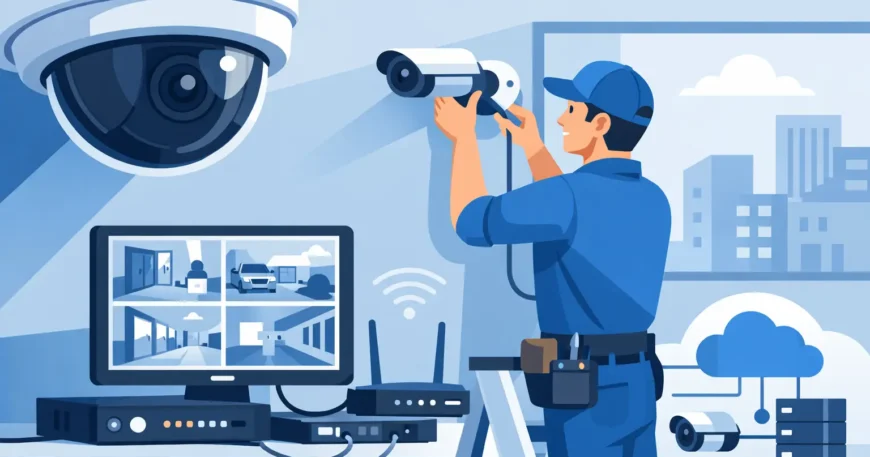
A camera system usually looks simple from the outside. A few cameras, a recorder, an app on your mobile, and the job seems done. In practice, ip video surveillance installation is only as good as the cabling, network design, camera placement, power planning, and setup work behind it. If any one of those parts is rushed, you end up with blind spots, patchy footage, unstable remote access, or a system that becomes expensive to fix later.
For businesses, strata properties, warehouses, apartment buildings, and homes, the goal is not just to put cameras on walls. The goal is to install a system that records what matters, works when needed, and can grow with the property. That takes proper planning and professional low-voltage installation, not guesswork.
What good IP video surveillance installation actually involves
IP cameras send video over a data network rather than through older analogue coax systems. That gives you better image quality, easier remote viewing, smarter analytics, and more flexibility across different property types. It also means the surveillance system now depends on your network infrastructure, switch capacity, cable quality, and device configuration.
A proper installation starts with the site itself. Entry points, loading areas, reception zones, lifts, corridors, car parks, stock areas, and perimeter lines all need different coverage strategies. A camera that works well at a front desk may be completely wrong for a dim warehouse aisle or an outdoor gate exposed to weather and glare.
That is why planning matters. Before installation starts, the better approach is to look at traffic flow, lighting conditions, mounting height, likely risks, and how long footage needs to be retained. Storage needs alone can vary a lot depending on image quality, frame rate, recording schedule, and the number of cameras on the system.
Why camera placement matters more than camera count
A common mistake is assuming more cameras automatically means better security. It does not. Ten poorly placed cameras can still miss faces, number plates, delivery zones, or after-hours access points. In some cases, fewer cameras with better positioning and correct lens selection will produce a far more useful result.
Placement should match the purpose of each view. If you need identification, the angle and distance must allow clear facial capture. If you need general monitoring, a wider view may make more sense. If the concern is vehicle movement, the camera needs to handle changing light and motion without turning footage into a blur.
This is where experienced installers save clients time and money. They know when a fixed camera is enough, when a varifocal model is the better option, and when an outdoor-rated unit or specialised low-light camera is worth the spend. The answer depends on the site, the risk, and the budget.
IP video surveillance installation and network performance
Because IP surveillance runs on your network, the camera system should never be treated as an afterthought. Each camera adds bandwidth demand, switch port usage, power load if you are using PoE, and storage requirements at the recorder or server level. On a small home setup, that may be straightforward. On a commercial site, warehouse, or multi-dwelling property, it can become a serious infrastructure consideration.
If the network is underbuilt, problems show up quickly. Cameras may drop offline, footage can lag, remote viewing becomes unreliable, and recording gaps start appearing. In larger properties, poor backbone design or weak termination work can create faults that are difficult to trace later.
That is why surveillance and structured cabling should be planned together. Clean Cat5e or Cat6 runs, properly installed switches, suitable PoE capacity, sensible rack layout, and tidy termination all make a difference. A well-installed system is easier to maintain, easier to expand, and far less likely to cause call-backs.
Different sites need different surveillance outcomes
A small office usually wants clear front entry coverage, reception visibility, after-hours monitoring, and secure recording access for managers. A warehouse often needs broader internal views, loading dock monitoring, perimeter coverage, and reliable camera uptime across longer cable runs. Apartment and mixed-use buildings may need shared area surveillance, lift lobby visibility, car park coverage, and controlled access integration.
Residential work has its own priorities. Homeowners often want front door visibility, driveway and side access coverage, backyard monitoring, and mobile access while away from home. They also care about clean installation and minimal disruption. Nobody wants surface cabling run badly across finished walls if there is a better option.
In retrofit environments, the job can become more complex. Existing buildings may have limited pathways, older network gear, restricted access points, or live occupancy that narrows installation windows. Those projects need a practical installer who can work around the building rather than force the building to suit the system.
Choosing the right equipment without overspending
Not every property needs premium hardware in every location. Spending more only makes sense where it improves the result. For example, a critical access point may justify higher resolution, better night performance, or advanced analytics, while a low-risk internal corridor may not.
The same goes for recorders, storage, and remote access platforms. Some sites need simple viewing and playback. Others need multi-user access, longer retention, event tagging, or integration with intercoms and access control. The right setup is the one that covers your operational needs without loading the job with unnecessary cost.
A straightforward installer will tell you where to spend and where to hold back. That matters because surveillance is rarely a one-device decision. Cameras, network switches, cabling, racks, power backup, mounting hardware, and labour all affect the total cost.
What to expect from a professional installation process
A reliable ip video surveillance installation process should feel organised from the start. First comes a discussion about the property, coverage goals, current network, and any existing camera equipment. Then comes site assessment, where practical issues such as cable pathways, mounting points, lighting, switch locations, and recorder placement are checked before work begins.
Installation itself should be neat and methodical. Cabling needs to be run properly, labelled where required, secured correctly, and terminated cleanly. Cameras should be mounted with stable positioning and tested for the actual field of view, not just pointed roughly in the right direction. Recording settings, motion rules, user access, and mobile viewing should be configured before handover.
Good commissioning also includes checking image quality during day and night conditions where possible. A camera that looks fine at midday can struggle badly after dark if headlights, shadows, or poor external lighting are part of the environment.
Common issues that come from rushed installs
Most surveillance complaints trace back to one of a few practical failures. Cameras are aimed too wide to identify anyone clearly. Storage is undersized, so footage is overwritten too quickly. Network switches do not provide enough PoE budget. Outdoor cable protection is poor. Remote viewing is left half-configured. Or the installation is technically working, but no one has shown the client how to use it properly.
These are avoidable problems. They happen when the focus is on getting cameras up quickly rather than delivering a complete working system. A proper job accounts for performance, maintenance, and usability from day one.
For clients managing multiple tenants, staff, or residents, reliability matters even more. If a system fails during an incident, the cost is not only in repairs. It can affect safety, liability, and confidence in the property.
When it pays to work with a single provider
Surveillance installation often overlaps with other low-voltage work. You may need new data cabling, a switch upgrade, cabinet clean-up, fibre links between buildings, or coordinated work with intercom and access systems. Using one provider for those connected services usually reduces delays, avoids finger-pointing, and keeps the project simpler.
That is especially useful in offices, warehouses, apartment buildings, and retrofit jobs where multiple systems share pathways and network infrastructure. A team that understands both surveillance and structured wiring can plan the whole job properly instead of treating each part in isolation.
Georgia Technical Services handles that kind of work every day, which is why clients call for more than just cameras. They need the cabling, network, installation, and support sorted properly the first time.
The best surveillance system is not the one with the longest spec sheet. It is the one that fits the site, records clearly, stays online, and gives you confidence when something actually happens.


Comments (2)
✏ Transaction to you.Go > graph.org/BALANCE-36824-US-DOLLARS-04-24-2?hs=60a6db4dd0a57ff10a529f6a7d0e68cb&
5s3pei
tairio66
Tairio66, alright! Time to see what you’re all about. Anyone here hit a big win on this site? Let’s hear the success stories! tairio66