

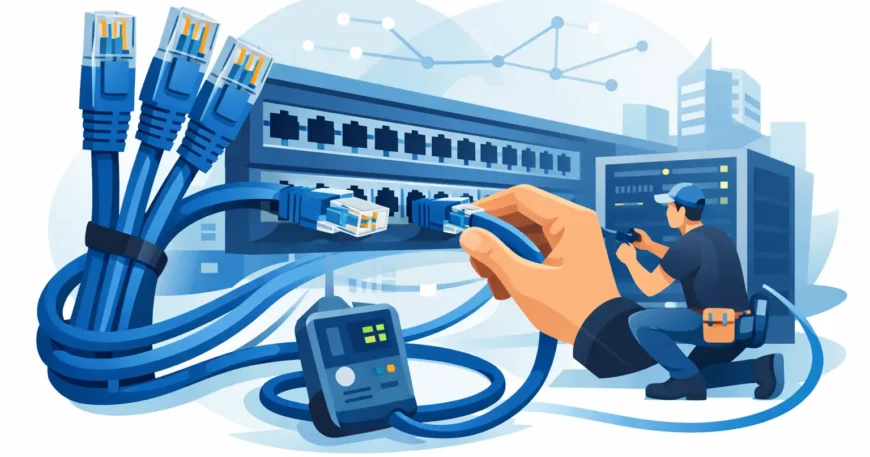
A slow network rarely starts with the internet plan. More often, it starts behind the wall – poor cable routing, messy terminations, bad patching, or a layout that was never designed for the way the property actually works. That is why cat6 data cabling installation matters. If you want stable speeds, reliable devices, and fewer call-outs later, the cabling has to be planned and installed properly from day one.
For businesses, that can mean keeping phones, workstations, printers, access points and CCTV online without random dropouts. For homeowners, it can mean stronger streaming, cleaner home office connectivity, and better performance across smart devices. For property managers and developers, it usually comes down to long-term value – install it once, install it cleanly, and avoid expensive rework.
What good cat6 data cabling installation actually delivers
Cat6 is still a practical choice for many sites because it gives you solid bandwidth, dependable performance, and room to scale without the cost of jumping straight to fibre everywhere. It suits offices, warehouses, homes, apartment buildings, retail sites, and mixed-use properties where you need reliable Ethernet across multiple endpoints.
The real benefit is not just the cable itself. It is the full system around it – cable runs, patch panels, wall plates, rack layout, testing, labelling and termination quality. A good installation gives you a network that is easy to manage and easy to expand. A rushed job often works at first, then causes faults that waste time for months.
That difference shows up quickly in busy environments. Staff lose time when desk connections fail. Wireless access points underperform when the wired backbone is poor. Security cameras become unreliable when power and data pathways are not properly considered. A clean structured cabling setup reduces those problems before they start.
Where Cat6 makes sense and where it depends
Cat6 suits most everyday commercial and residential applications. If you are fitting out a small office, upgrading a warehouse, renovating a home, or wiring a multi-dwelling property, it is often the right balance of cost and performance. It supports modern networking needs well when installed to standard and matched with suitable switching hardware.
That said, not every project is identical. In a large site with long runs, high device density, or major backbone requirements, fibre may be the better option for part of the network. In some retrofit environments, the path through existing walls and risers can shape the design as much as the technical spec. The right answer depends on the building, the number of endpoints, future growth, and how the network will be used day to day.
This is where experience matters. A warehouse with scanners, VoIP phones, cameras and office workstations has different cabling priorities than a high-rise apartment retrofit or a detached home with a media room and home office. Good planning avoids overbuilding where it is unnecessary and underbuilding where future demand is obvious.
Planning the installation before cable goes in
The best installations start with a site-specific plan. That means identifying where the data points should go, where the network equipment will live, how cables will be routed, and what future additions are likely. It is much cheaper to make good decisions on paper than to shift outlets and rerun cable later.
In a commercial fit-out, that planning usually covers workstations, wireless access points, printers, phones, security devices, boardrooms and any specialist systems that rely on network connectivity. In residential projects, it may include TVs, gaming areas, study spaces, CCTV, smart home hubs and outdoor access points. In apartment and MDU work, the design also needs to account for shared infrastructure, risers, unit distribution and serviceability.
A proper plan also considers practical site conditions. Ceiling space, wall type, access limitations, interference sources and equipment placement all affect the final result. There is no value in specifying a neat network layout if the rack ends up in a hot cupboard with poor ventilation and no room for expansion.
The installation stage: neat work matters
Anyone can pull cable through a ceiling. Professional installation is about doing it in a way that protects performance and makes the system supportable long term. Cables should be routed cleanly, supported correctly, and kept clear of sources of interference where possible. Bend radius, separation, pathway management and termination quality are not small details – they directly affect reliability.
This is especially important on larger sites. In offices and warehouses, poor cable management becomes obvious very quickly once multiple trades and systems are involved. In homes, the issues are often hidden at first, then surface when rooms are rearranged, extra devices are added, or faults need tracing. A neat installation saves time every time the network needs to be changed, tested or expanded.
Labelling is another area that gets overlooked. If each run is clearly identified at both ends, future troubleshooting is straightforward. If not, even a simple move or fault can turn into a time-consuming process. Good installers think beyond handover day.
Testing, certification and handover
A cable run is not finished just because the outlet is mounted and the patch panel looks tidy. Every run should be tested properly to confirm performance and identify faults before the site is handed over. That includes checking continuity, termination quality and overall link performance.
This step protects the client as much as the installer. Without testing, problems can sit unnoticed until users move in and start depending on the network. At that point, diagnosing faults is more disruptive and more expensive. Proper handover should also include a clear understanding of what has been installed, where the key equipment sits, and how the layout supports future additions.
For business and property clients, this matters because the cabling is part of the building infrastructure. It should not feel temporary or improvised. It should feel like a system that was designed to support operations.
Common mistakes that cost more later
The most expensive cabling mistakes are usually the ones that looked cheaper at the start. Underestimating the number of outlets is common. So is placing network equipment in the wrong location, skipping proper patching hardware, or trying to mix old and new cabling without a clear plan.
Another issue is treating wireless as a replacement for structured cabling. Wi-Fi is essential, but it still depends on a strong wired backbone. If access points, cameras and workstations are relying on poor cabling, the wireless experience suffers as well. The better approach is to treat cabling and wireless as one system.
Retrofit work brings its own risks. Existing buildings often hide access challenges, legacy wiring and space constraints. That does not mean the result has to be messy, but it does mean the installer needs to know how to adapt the design without cutting corners.
Choosing the right installer for Cat6 work
If you are comparing providers, look beyond the price per cable run. The cheaper quote can become the expensive job if it leaves out planning, testing, clean termination work, or support for related systems. A network is rarely just a few data points. It often ties into phones, cameras, wireless access, server equipment, intercoms and broader low-voltage infrastructure.
That is why many clients prefer a single contractor who can handle the full scope, especially on business sites and multi-dwelling properties. It reduces coordination issues and makes the result more consistent. Georgia Technical Services works in exactly that space – practical, professional installation for clients who need the job done properly, without unnecessary complication.
A good installer should also be realistic. Sometimes the right answer is a staged rollout. Sometimes it is worth spending a little more now to avoid major disruption later. Sometimes an older site needs a mix of upgrades rather than a full replacement. Straight advice matters as much as technical skill.
Why this work pays off over time
Well-installed Cat6 cabling supports more than internet access. It supports productivity, security, communication and property usability. In a business, that can mean fewer interruptions and easier growth. In a home, it can mean a better day-to-day experience across work, entertainment and smart devices. In apartment and retrofit projects, it can improve the value and appeal of the property for years.
The best result is not flashy. It is a network you do not have to think about because it simply works. If you are planning cabling for a new fit-out, an upgrade, or a retrofit, start with the layout, the use case, and the long-term plan. Good cabling is quiet infrastructure, but it carries a lot of the load.

