

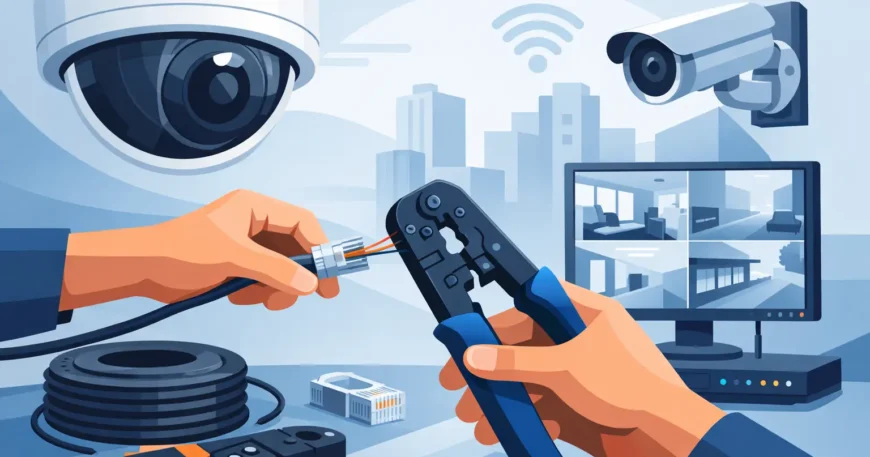
A blurry image or an offline camera rarely starts at the camera itself. More often, the problem begins behind the wall, above the ceiling, or out in the riser where poor cable choice, rushed routing or weak terminations create faults that show up later. That is why cctv camera cabling installation needs to be treated as infrastructure, not just a quick add-on to a security job.
For property managers, business owners and homeowners, the goal is simple: clear footage, stable performance and a system that keeps working when you need it. The cabling is what makes that possible. If it is planned properly from the start, the cameras perform better, maintenance is easier and future expansion costs less.
Why CCTV camera cabling installation matters
A surveillance system is only as reliable as the path carrying power and data. You can invest in high-resolution cameras, quality recorders and a decent monitoring setup, but if the cable run is too long, poorly protected or badly terminated, the whole system suffers.
In a small house, that might mean one camera dropping out whenever the weather turns. In an office or warehouse, it can mean intermittent faults that waste staff time and leave blind spots. In apartment buildings and retrofit projects, poor cabling choices can become a much larger cost because access is harder and remedial work is more disruptive.
Good installation work is not only about making it function today. It is about making sure the system can be serviced, upgraded and trusted over time. That is especially important for sites that expect growth, changing layouts or additional security requirements.
Choosing the right cable for the job
The right cable depends on the camera type, the site layout and how the system is powered. There is no single answer that suits every property.
For traditional analogue systems, coaxial cabling may still be appropriate, particularly where an older installation is being upgraded in stages. In those cases, reusing sound existing pathways can reduce cost. The trade-off is that analogue infrastructure can limit flexibility compared with modern IP systems.
For IP surveillance, Cat5e or Cat6 is usually the better fit. It supports data transmission cleanly and often allows Power over Ethernet, which means both power and data can travel through one cable. That simplifies installation and can reduce clutter, especially in offices, retail spaces and residential builds.
Cat6 is often worth considering where longer-term performance matters or where the wider network infrastructure is already being upgraded. It can provide better headroom and may suit projects where cameras, wireless access points and other low-voltage systems are being planned together. That said, Cat5e remains a practical and cost-effective choice for many CCTV applications when installed correctly.
Fibre also has a place, particularly across large warehouses, multi-building sites, campuses or multi-dwelling properties. When the distance is beyond copper limits or electrical interference is a concern, fibre backbone links can make the system more stable and scalable.
Planning cable routes before installation starts
This is where experienced installers earn their keep. A clean system does not happen by luck. Cable paths need to be mapped with the building in mind.
That includes ceiling spaces, wall cavities, risers, external runs, plant rooms and comms areas. It also means thinking about how the cable will be protected from moisture, heat, physical damage and interference. In a warehouse, for example, cable location must account for forklift traffic, high shelving and long spans. In a home, the challenge may be preserving neat finishes and avoiding unnecessary wall damage.
For commercial and MDU work, route planning also affects how easy the system will be to maintain later. A cable run that saves thirty minutes on install day can become a recurring headache if it ends up inaccessible or undocumented.
Power, data and distance limitations
One of the most common mistakes in CCTV camera cabling installation is assuming every run can be treated the same way. Distance matters. Power draw matters. So does the environment.
PoE simplifies many installations, but each camera still has power requirements, and longer runs can affect performance. Some sites need local power supplies, midspan injectors or properly designed switch layouts rather than a one-size-fits-all approach. External cameras with heaters, infrared or PTZ features can place greater demand on the system than standard fixed cameras.
There is also the issue of electrical interference. Running surveillance cable too close to mains power can create problems, especially in busy commercial environments. Proper separation and pathway planning help avoid faults that are hard to diagnose once the ceilings are closed up.
This is why design and installation should work together. It is not enough to know where the cameras are going. You also need to know what each run is asking the cabling infrastructure to do.
What a professional installation should include
A proper cabling job is more than pulling wire from point A to point B. It should include site assessment, cable selection, route planning, neat routing, secure support, correct terminations, labelling and final testing.
Testing matters because not every fault is visible during installation. A cable may appear connected but still underperform due to poor termination, damage during pulling or inconsistent pinout. Without testing, those issues often show up later as random dropouts, packet loss or unstable power delivery.
Labelling is just as practical. On a single home install, it may seem optional. On a larger site with multiple switches, patch points, recorders and future expansion plans, it saves time every time someone needs to troubleshoot or add equipment.
Neatness also has a real operational benefit. Tidy, supported cable runs are easier to inspect, less likely to be damaged and more straightforward to expand. That matters in server rooms, risers, network cabinets and any site where multiple low-voltage systems share space.
New builds, retrofits and live sites all need a different approach
A new build gives you the best chance to install cleanly and plan for future growth. Cable can be concealed properly, pathways can be coordinated with other trades and camera positions can be aligned with the overall building layout.
Retrofits are different. Existing walls, occupied spaces and legacy infrastructure can all shape the installation. In older commercial buildings or apartment blocks, there may be limited pathways, difficult access and a need to work around tenants or business operations. That does not mean the result has to be second-rate, but it does mean the installer needs practical experience and a flexible plan.
Live sites add another layer. Offices, warehouses, shops and residential complexes often need work carried out with minimal disruption. That affects scheduling, access methods and how visible the installation process can be. In these cases, fast response and efficient workmanship are not just nice to have. They keep the project moving without disrupting the people using the space.
When to upgrade existing CCTV cabling
Not every older cable run needs to be replaced immediately. If the infrastructure is sound and suited to the system, selective upgrades may be enough. But there are clear signs that a cabling refresh should be part of the job.
Frequent camera dropouts, poor picture quality, damaged external runs, overloaded power arrangements and undocumented cable paths all point to bigger underlying issues. The same applies when a site is moving from analogue to IP or expanding beyond what the original layout was designed to support.
For property owners, this is often where a broader low-voltage review makes sense. CCTV, data cabling, intercoms and internet distribution are often linked in practice, especially in apartment buildings, office fit-outs and mixed-use properties. Planning them together can reduce duplicated labour and produce a cleaner result.
Getting the job done properly the first time
The cheapest install is not always the most affordable one. If poor routing, low-grade cable or rushed terminations lead to call-backs, faults and replacement work, the cost rises quickly.
A dependable installer looks at the whole site, not just the camera locations. They consider coverage, cable type, power, access, future additions and how the surveillance system fits within the wider network or low-voltage setup. That approach is especially valuable for businesses, multi-dwelling properties and larger homes where the infrastructure needs to support more than one service.
For clients who want a single solution, Georgia Technical Services approaches CCTV cabling the same way it handles structured wiring and network infrastructure – practical planning, professional installation and a result that is built to last.
If you are planning a new security system or fixing one that has never worked quite right, start with the cabling. Good footage and dependable performance usually begin where most people never look.

