

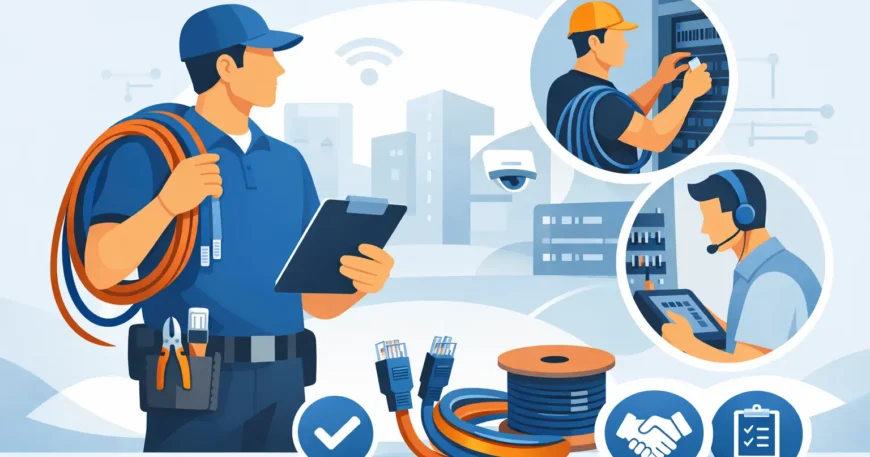
When your internet drops out in the middle of business, your CCTV keeps losing signal, or a new fit-out needs data points in every room, the quality of the install shows up fast. Low voltage wiring contractors are not just there to pull cable. They affect reliability, fault finding, future upgrades, and how much disruption you deal with during the job.
For business owners, property managers, warehouse operators and homeowners, the right contractor saves time and avoids expensive rework. The wrong one can leave you with patchy Wi-Fi, messy comms cupboards, poor labelling, and a network that becomes harder to maintain every time someone touches it. That is why contractor selection matters well before the first cable run starts.
What low voltage wiring contractors actually do
Low voltage work covers much more than internet cabling. In practical terms, it includes structured data cabling, Ethernet points, Cat5e and Cat6 installation, fibre backbone runs, telephone and VOIP systems, CCTV and IP surveillance, intercoms, paging systems, server room fit-outs, conference room cabling and network tidy-ups. In many properties, these systems overlap, which is why a single contractor with broad capability can make the project simpler.
That matters even more in commercial spaces and multi-dwelling buildings. An office may need workstations, wireless access points, phones, cameras and boardroom connectivity all planned together. An apartment complex may need backbone infrastructure, riser cabling and unit-by-unit distribution designed to support long-term internet delivery. If different trades handle each piece without a clear plan, faults and delays usually follow.
Why experience matters more than a low quote
Price matters. No one wants to overspend on cabling or network infrastructure. But low voltage work is one of those areas where the cheapest quote can become the most expensive once faults, delays or upgrades start piling up.
An experienced contractor looks beyond the cable itself. They consider cable pathways, termination quality, equipment locations, rack layout, testing, labelling and how the system will be serviced later. They also know how to work in occupied buildings, active offices, residential homes and warehouse environments without turning the site upside down.
There is also the question of scalability. A basic install may meet today’s need, but if it leaves no room for expansion, you can end up paying again when staff numbers grow, tenants change, or devices increase. Good contractors will tell you when a simple solution is enough and when it makes sense to allow for future capacity. That balance is where real value sits.
What to ask low voltage wiring contractors before hiring
A good conversation at the quoting stage can tell you a lot. You want to know whether the contractor is thinking practically about the job or simply pricing metres of cable.
Start with scope. Ask what systems they handle in-house and whether they can manage the full low-voltage side of the project. If you need data, phones, CCTV and fibre, dealing with one team is often easier than coordinating multiple vendors.
Then ask how they approach planning. A capable contractor should be able to explain cable routes, cabinet locations, patching, outlet placement and expected disruption in plain language. If the building is older, occupied or being retrofitted, this matters even more. Retrofit work often involves hidden obstacles, limited access and existing infrastructure that may or may not be usable.
Testing and documentation should also be part of the discussion. You should know whether cables will be labelled, tested and handed over in a way that makes future maintenance easier. Clean work is not just about appearance. It affects fault isolation, upgrade speed and service continuity.
Response time is another practical issue. For many businesses and managed properties, waiting days for a fault visit is not workable. If your site depends on connectivity, same-day availability or emergency response can be a deciding factor.
The signs of a professional installation
The best low-voltage jobs often go unnoticed once they are complete. Everything just works. Devices connect properly, cameras stay online, patch panels are labelled, and the comms area is laid out so another technician can understand it later.
Professional installation usually shows up in a few ways. Cable runs are neat and protected. Terminations are consistent. Equipment is mounted sensibly. Network cabinets are not overloaded or left in disorder. The contractor also communicates clearly about what was installed, what was tested and what to watch for as the site grows.
For residential customers, this might mean Ethernet to key rooms, access points positioned for proper coverage, smart home and surveillance cabling kept tidy, and enough capacity for future devices. For commercial clients, it often means structured cabling that supports daily operations without becoming a headache every time desks move or equipment changes.
Different property types need different approaches
Not every site should be handled the same way. A small office fit-out has very different needs from a warehouse, a detached home or a high-rise apartment building.
In offices, the priority is often reliable workstation connectivity, VOIP, Wi-Fi support and meeting room infrastructure. Downtime can affect staff immediately, so staging and scheduling matter.
In warehouses, cable protection, equipment placement and long-distance runs become more important. Environmental conditions and building layout can affect both design and installation method.
In homes, customers usually care about strong internet performance, discreet installation and practical coverage across living areas, home offices, entertainment spaces and security systems. The work needs to be effective without making the house look like a construction site.
For MDUs and retrofit buildings, planning is even more critical. Owners and managers want infrastructure that improves service capability and adds long-term property value. In some cases, owner-supplied internet infrastructure can create a strong return over time, but only if the backbone and distribution are installed properly from the start. This is specialised work, and not every contractor is equipped for it.
When a single-source contractor makes sense
A lot of customers start by asking for one thing, such as a few data points or a CCTV upgrade. Once the site is reviewed, it becomes clear that several systems are connected. That is where working with a single-source provider can save time and money.
If one team can handle structured cabling, fibre, surveillance, phones, intercoms, paging and network room setup, there is less back-and-forth and fewer gaps between trades. It also means the design is more likely to work as a complete system rather than a collection of disconnected installs.
That does not mean one provider is always the answer. For highly specialised or unusually large projects, some clients may still need multiple parties involved. But for most residential, commercial and property infrastructure jobs, a contractor with broad low-voltage capability tends to reduce complexity.
Common mistakes to avoid
One of the biggest mistakes is treating low-voltage wiring like an afterthought. Cabling usually becomes harder and dearer once walls are closed, tenants move in, or the fit-out is complete. Early planning nearly always gives you better outcomes.
Another mistake is focusing only on visible endpoints. Data outlets, cameras and phones may be what users see, but the backbone, patching and cabinet setup behind them matter just as much. Weak points in those areas often cause the faults people blame on internet providers or hardware.
It is also easy to underestimate the value of clean documentation. In busy sites, especially commercial and multi-tenant buildings, poor labelling can waste hours during maintenance. What seems minor on day one becomes costly over the life of the system.
Choosing a contractor for the long term
The best contractor is not always the one with the biggest sales pitch. It is the one that understands how your property works, recommends a sensible solution, installs it properly and responds when you need support.
That means looking for practical experience, broad service capability, clear communication and a realistic approach to budget. It also means choosing a team that can work across different environments, from homes and offices to warehouses and apartment buildings, without making the project more complicated than it needs to be.
For clients who need dependable cabling, CCTV, fibre, Ethernet or structured wiring without the run-around, a provider such as Georgia Technical Services stands out because the focus stays on getting the job done properly, affordably and with minimal disruption.
If you are comparing options, look past the quote total and ask a better question: will this installation still make sense for your property two years from now? That is usually where the right decision becomes obvious.

