

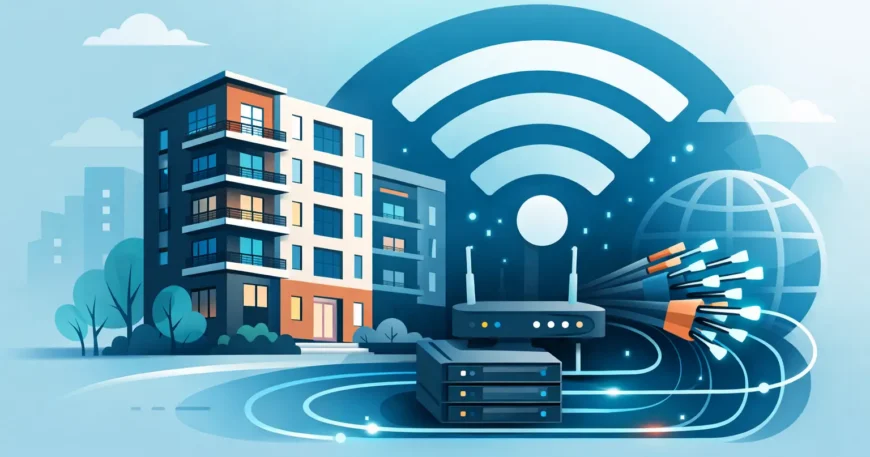
When tenants complain that video calls keep dropping, smart locks lag, and streaming buffers every night, the problem usually is not the retail internet plan. It is the apartment building internet infrastructure behind it. In multi-dwelling properties, weak cabling, poor pathway planning, limited riser space, and patchwork upgrades create the kind of connectivity issues that frustrate residents and cost owners money.
For apartment owners, developers, and property managers, internet infrastructure is no longer a nice extra. It is part of the building’s core utility mix, right alongside power, water, access control, and security. Prospective tenants ask about internet before they sign. Existing tenants judge the property by how well their home office, mobile devices, televisions, intercoms, and smart home equipment actually work once they move in.
What apartment building internet infrastructure really includes
A lot of people use the term loosely. In practice, apartment building internet infrastructure is the full physical and network foundation that gets reliable connectivity from the provider handoff to each unit and shared area. That includes fibre backbone, structured cabling, risers, conduits, termination points, equipment rooms, network racks, switching, and the low-voltage pathways that support future upgrades.
In a smaller property, the design may be fairly straightforward. In a high-rise, mixed-use building, or retrofit project, it becomes much more complex. You may be dealing with old telephone cabling, limited penetrations, asbestos concerns, overcrowded telecom closets, and units that were never designed for modern bandwidth demand.
That is where planning matters. A building can have fast service available at the street and still deliver poor tenant experience if the internal distribution is badly designed or installed.
Why old cabling causes new problems
Many apartment buildings still rely on infrastructure installed for another era. It may have been built for voice, basic television distribution, or light internet usage. That does not hold up when every resident has multiple mobiles, smart TVs, gaming systems, work laptops, wireless cameras, and connected appliances all running at once.
Older Cat3 or poorly terminated legacy cabling often becomes the bottleneck. So do improvised upgrades done unit by unit over time. One resident gets a line run here, another gets a quick fix there, and eventually the property ends up with a messy, inconsistent system that is harder to troubleshoot and more expensive to maintain.
Even where Wi-Fi is the visible issue, the underlying problem is often the wired network. Wireless performance depends heavily on good backhaul, proper equipment placement, and stable structured cabling. If the building backbone is weak, adding more access points will not fix the root cause.
The main decisions owners need to make
The first question is whether the property needs a fresh installation, a staged upgrade, or a full retrofit. That depends on the age of the building, the condition of existing cabling, available pathways, and the business goal.
Some owners simply want to reduce tenant complaints and support modern usage. Others are looking at owner-supplied infrastructure as a long-term asset that can improve occupancy, support premium rents, or increase resale appeal. In some MDU projects, putting the right backbone in place now also makes future provider arrangements far easier.
The second question is how far to build for future demand. Cat6 cabling, fibre backbone, and properly designed telecom spaces cost more upfront than the cheapest basic option. But cutting corners can mean reopening walls, rerouting pathways, and replacing components much sooner than expected. The right answer depends on the building type, target tenant profile, and budget, but underbuilding rarely saves money for long.
Apartment building internet infrastructure for new builds vs retrofits
New construction gives you more control. Pathways can be designed before walls are closed, risers can be sized properly, and unit layouts can include practical data point locations from day one. This usually means a cleaner installation, better scalability, and fewer labour complications.
Retrofits are different. They require more problem-solving and more care around live occupancy. Installers may need to work around finished interiors, existing electrical services, access restrictions, and residents’ schedules. In a lived-in building, the standard is not just whether the system works. It is whether the upgrade can be completed with minimal disruption and a tidy finish.
Retrofitting converted office buildings into apartments adds another layer. The original layout may not suit unit-by-unit internet distribution at all. Riser placement, wall types, and telecom room locations often need rethinking. This is where experienced low-voltage design and installation makes a real difference.
The backbone matters more than most people realise
If there is one place not to cut corners, it is the backbone. Fibre between building entry, equipment rooms, and key distribution points gives the property room to grow. It supports higher capacity, longer runs, and easier scaling than relying purely on copper in the wrong places.
That does not mean every part of the building has to be fibre-only. In many properties, a practical mix works best – fibre for the backbone and Cat6 to units or local distribution points. The key is designing the system around distance, bandwidth needs, maintenance access, and future expansion.
This is also where proper termination, labelling, and testing matter. A network is only as serviceable as its documentation. If no one can quickly identify runs, patching, or fault locations, simple service calls become drawn-out and expensive.
Shared spaces, smart systems, and hidden demand
Internet infrastructure in apartment buildings is not just about resident units. Shared spaces increasingly need dependable connectivity as well. Leasing offices, CCTV systems, intercoms, access control, lifts interface points, smart parcel rooms, digital signage, and common-area Wi-Fi all place demand on the same broader low-voltage environment.
If these systems are planned separately, conflicts appear quickly. You end up with overloaded pathways, power issues, cluttered cabinets, and competing contractors making changes without a whole-of-building view. A coordinated design approach avoids that. It keeps security, communications, and data services working together instead of fighting for space.
What a good installation should deliver
From an owner or manager’s perspective, a successful project should do more than pass a test result. It should give the building dependable service, cleaner infrastructure, simpler maintenance, and a clear path for growth.
That means properly installed Cat5e or Cat6 where suitable, fibre backbone where capacity calls for it, organised racks and patch panels, sensible unit termination points, and pathways that allow future additions without tearing the place apart. It also means the work is completed safely, professionally, and with enough foresight that the property does not need another major overhaul too soon.
For occupied properties, good project delivery also includes communication, scheduling, and responsiveness. Same-day support and fast fault response can matter just as much as the initial install, especially where internet issues affect multiple tenants at once.
Common mistakes that cost more later
The most expensive mistake is treating apartment connectivity as a series of one-off fixes. Another is assuming the provider will handle everything inside the building. Providers can deliver service to the property, but internal distribution is often where the real performance problem sits.
A third mistake is ignoring low-voltage infrastructure until the final stage of a construction or renovation project. By then, pathways are limited, wall access is gone, and the cheapest route is usually the messiest one.
There is also a tendency to build only for current use. That can look sensible on a spreadsheet, but buildings outlast device cycles by a long margin. What feels adequate today may feel dated much sooner than expected.
Choosing the right partner for the job
Apartment projects need more than a cable installer. They need a team that understands structured cabling, fibre backbone, MDU layouts, retrofit constraints, equipment spaces, and the practical realities of working in active properties.
That includes design, pathway planning, installation, termination, testing, and support after handover. It also helps to work with one contractor that can handle related low-voltage systems at the same time, rather than forcing multiple trades into the same risers and cupboards without coordination.
For owners and managers, the value is straightforward. Better infrastructure means fewer complaints, cleaner upgrades, and a property that is easier to lease and manage. For many buildings, it also creates a stronger long-term return than continuing to patch an outdated system. That is why experienced providers such as Georgia Technical Services focus on practical, end-to-end solutions rather than temporary fixes.
If your building’s internet performance depends on luck, tenant workarounds, or repeated service calls, the infrastructure is probably overdue for a closer look. The right upgrade is not about chasing buzzwords. It is about giving the property a dependable foundation that works properly now and still makes sense five years from now.

