

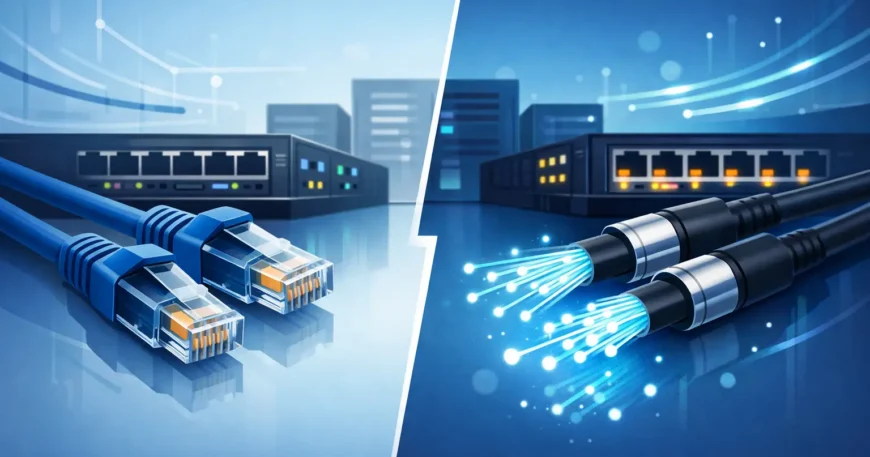
When a site starts outgrowing patchy Wi-Fi, overloaded switches or old cabling, the cat6 vs fibre backbone question usually shows up fast. It comes up in office fit-outs, warehouse upgrades, apartment retrofits and even larger homes where reliable connectivity matters more than marketing claims. The right answer is not about picking the newer or more expensive option. It is about matching the backbone of the network to the building, the distance and the long-term plan.
For most property owners and managers, the real issue is simple – where should copper end, and where should fibre begin? If you get that split right, you avoid wasted spend, bottlenecks and painful rework later.
Cat6 vs fibre backbone: the basic difference
Cat6 is copper cabling designed to carry Ethernet data over relatively short runs. It is common for workstations, phones, wireless access points, CCTV cameras and other endpoint devices. It is affordable, widely supported and practical for horizontal cabling from the communications rack out to individual rooms or device locations.
Fibre backbone cabling is different. It is typically used to connect one network cabinet to another, one floor to another, one building to another, or an incoming service to a central distribution point. Fibre is built for higher bandwidth over longer distances, and it is not affected by electrical interference in the same way copper can be.
That distinction matters because these two cabling types are often not competing solutions in a well-designed network. They are complementary. In many projects, Cat6 handles the last leg to devices, while fibre handles the backbone between key network points.
Where Cat6 makes the most sense
Cat6 is still the practical choice for a lot of installations. In standard office layouts, retail spaces, classrooms and homes, most device runs stay well within the 100-metre Ethernet limit. That makes Cat6 a strong fit for desks, printers, TVs, cameras, access control devices and wireless access points.
It also supports Power over Ethernet, which is a major advantage in real installations. A single Cat6 cable can carry both data and power to many devices, reducing the need for separate electrical work at each location. For CCTV, VoIP handsets, door stations and ceiling-mounted access points, that keeps installations cleaner and more affordable.
Cat6 also suits customers who need dependable performance without overbuilding. If you are wiring a small office suite, a fit-out with one comms room, or a home network where all runs stay local, fibre may add cost and complexity without delivering much real-world benefit.
That said, Cat6 has clear limits. Distance is the big one. Once runs get longer, performance and standards compliance become an issue. Copper is also more exposed to electromagnetic interference, which can matter in warehouses, plant areas and buildings with more demanding electrical environments.
When fibre backbone is the better call
Fibre backbone cabling starts to make more sense when the site is larger, more complex or expected to grow. If you need to connect multiple comms cabinets across several floors, link separate buildings on the same property, or build out infrastructure for a multi-dwelling property, fibre is usually the smarter long-term move.
Bandwidth is one reason. Fibre gives you more headroom for current traffic and future upgrades. Even if your network does not need very high throughput today, backbone links can become crowded quickly once more users, access points, cameras, cloud applications and tenant services are added.
Distance is another reason. Fibre can handle much longer runs than Cat6 without the same concerns around loss and speed limitations. On a warehouse site, a school campus, a detached office block or a high-rise property, that is often the deciding factor.
There is also resilience. Fibre is immune to electromagnetic interference, which helps in environments where copper can be less predictable. For buildings with lift equipment, heavy electrical loads or noisy industrial infrastructure nearby, that can improve stability.
Cost is not as simple as copper is cheap and fibre is expensive
A lot of buyers assume Cat6 always wins on price. Sometimes it does, especially on small jobs with short runs and simple layouts. But backbone decisions should not be based on cable price alone.
With Cat6, you may spend less upfront on materials and active hardware. The catch is that copper backbones can create limitations sooner. If the network later needs more capacity, more cabinets, or longer interconnections, the original savings can disappear into labour, disruption and replacement work.
Fibre often costs more at the start, particularly once you factor in termination, testing and the optical hardware. But on larger sites, that extra spend can protect the network from early obsolescence. It can also reduce the need for intermediate cabinets or workaround designs just to stay within copper distance limits.
For property owners, especially in MDUs and retrofit projects, this matters. A backbone is not the part of the network you want to revisit every couple of years. If the building is expected to support more tenants, more services or owner-controlled internet distribution, fibre can be the more cost-effective choice over the life of the asset.
Performance, scalability and what future-proofing really means
Future-proofing gets thrown around too loosely. It should not mean paying for the biggest possible infrastructure just because it sounds safe. It should mean installing a system that fits realistic growth without forcing a major rebuild.
Cat6 is still perfectly valid for many modern networks. Gigabit performance to devices is enough for a large share of users, and even more demanding endpoints can often be managed well with good switching and sensible design. For a small office or residential setup, Cat6 may be all that is needed in practical terms.
Fibre backbone becomes more attractive when the network needs room to expand. More wireless access points, higher camera counts, shared internet services across multiple units, centralised security systems and heavier cloud usage all place more load on backbone links than many customers expect.
This is where planning matters more than product labels. If a site has one cabinet and stable demand, Cat6 may be enough. If there are multiple floors, staged tenancy growth or plans to add more networked systems over time, fibre backbone infrastructure usually gives you a cleaner upgrade path.
The best answer for most sites is both
In real-world structured cabling, Cat6 vs fibre backbone is often the wrong framing if it suggests you must choose one for everything. Most well-built networks use both because each serves a different purpose.
A common setup is fibre between the main rack and IDFs, then Cat6 from those local cabinets out to devices. That design keeps the backbone fast and scalable while preserving the simplicity and PoE benefits of copper where they matter most. It is also easier to troubleshoot, easier to expand and usually more sensible on cost than trying to force one cable type into every role.
This mixed approach is especially effective in apartment buildings, office floors, warehouses and larger homes with detached structures or multiple network zones. Fibre handles the long-haul links. Cat6 handles the practical day-to-day device connections.
Choosing based on the building, not the brochure
The right decision depends on a few straightforward questions. How far are the runs? How many cabinets or buildings need to be linked? What devices need PoE? How much growth is likely over the next few years? And how disruptive would it be to upgrade the backbone later?
A single-storey office with one communications room may have no reason to install a fibre backbone. A multi-level site with separate risers almost certainly does. A warehouse with long cable paths may benefit from fibre sooner than an office of the same floor area. An apartment owner planning to improve connectivity across the property should think in terms of long-term infrastructure, not just immediate tenant demand.
This is where proper site assessment pays off. Good cabling design is not about pushing the most expensive option. It is about installing the right infrastructure once, testing it properly and leaving room for the next stage of growth.
At Georgia Technical Services, that practical approach is what keeps projects on budget and networks dependable. Not every site needs fibre everywhere. Not every site should rely on copper for the backbone either.
If you are weighing up Cat6 and fibre, think less about which one sounds better and more about what your building needs to do, now and after the next upgrade cycle. A network should make the property easier to run, not become the next problem you have to fix.

