

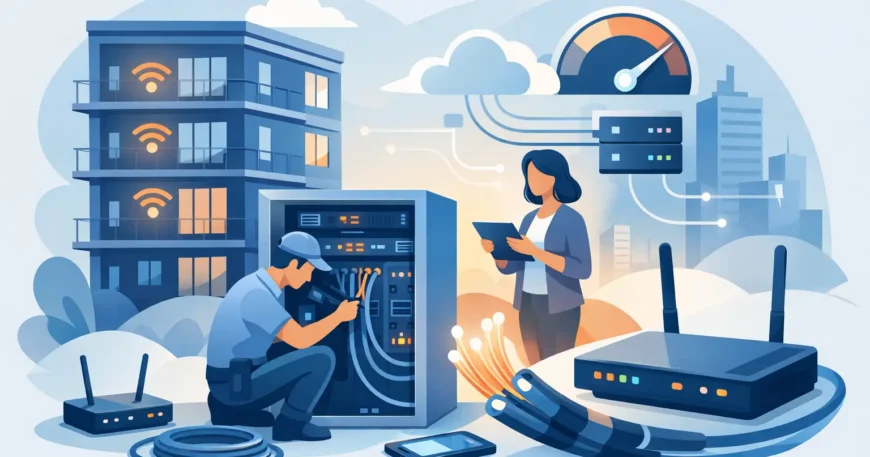
If your apartment building still relies on ageing phone pairs, patchwork Wi-Fi extenders, or a single ISP handoff feeding too many residents, complaints are not going away on their own. Knowing how to upgrade apartment internet infrastructure starts with one practical question – are you fixing a coverage problem, a capacity problem, or a building wiring problem? In most multi-dwelling properties, it is a mix of all three.
For owners, developers, and property managers, the stakes are straightforward. Poor internet affects tenant satisfaction, leasing appeal, smart building systems, security devices, and the building’s long-term value. A proper upgrade is not just about faster speeds advertised on a flyer. It is about building dependable infrastructure that can support today’s demand and still make sense five to ten years from now.
How to upgrade apartment internet infrastructure without wasting money
The fastest way to overspend is to start with equipment before understanding the building. Apartment internet issues are often blamed on routers, but the real bottlenecks usually sit in the backbone, risers, unit cabling, or telecom room layout. A clean plan starts with a site assessment.
That assessment should look at the incoming service, existing pathways, MDF and IDF spaces, vertical risers, horizontal runs, and what type of cabling is already in place. In some properties, older Cat5 can still be used for certain runs. In others, it makes more sense to replace everything with Cat6 and build around a fibre backbone. It depends on the building size, wall construction, access constraints, and the service level you want to offer tenants.
A lot of apartment owners try to solve a building-wide issue unit by unit. That usually creates inconsistent performance, more maintenance calls, and no clear standard for future tenants. A structured approach costs more upfront, but it gives you control over performance, easier fault finding, and better return on investment.
Start with the building backbone
In most apartment upgrades, the backbone matters more than the endpoint gear. If the main feed into the building is limited, or if the distribution from the telecom room to each level is undersized, no amount of premium Wi-Fi hardware inside individual units will fix the problem.
For low-rise and high-rise properties alike, fibre backbone infrastructure is often the right place to invest first. Fibre gives you the bandwidth headroom to serve multiple floors and future services without rebuilding the core every few years. From there, Ethernet cabling to each unit or floor distribution point creates a more manageable and scalable layout.
This is especially relevant in retrofit work. Older MDUs often have awkward pathways, limited conduit space, or outdated comms cupboards. A professional design can work around those limitations without turning the project into a major construction exercise. Sometimes that means reusing viable pathways. Sometimes it means installing new riser routes and wall penetrations because the old layout was never intended for modern internet demand.
Fibre to the floor or fibre to the unit?
This decision depends on budget, access, and the service model. Fibre to each floor with copper distribution to units can be a sensible balance for many buildings. Fibre to each unit offers stronger long-term capacity and can be attractive for premium properties or owner-operated internet infrastructure.
There is no universal answer. A smaller building may not need fibre to every unit right away. A larger complex with hundreds of residents probably should not build a new system around legacy copper if the goal is to reduce future upgrade costs.
Unit cabling is where performance becomes visible
Residents do not care what is inside the riser if their streaming buffers in the lounge room or their work call drops in the spare bedroom. That is why the last stretch into the unit matters.
Where possible, hardwired Ethernet should be part of the plan. Cat6 cabling to key locations inside each apartment gives tenants a far better experience for smart TVs, workstations, gaming, access points, and VOIP services than relying on one Wi-Fi router in a cupboard. It also makes the unit more attractive to renters who work from home or expect stable connectivity across multiple devices.
If the building is occupied, staged installation becomes important. You want minimal disruption, clear access planning, and consistent termination standards across every unit. Messy retrofits create service issues later. Neat patching, labelled terminations, tested drops, and properly mounted hardware save time long after the installers leave site.
Don’t treat Wi-Fi as the whole solution
Wi-Fi is part of apartment internet infrastructure, but it should sit on top of good cabling rather than replace it. Thick concrete walls, metal framing, crowded radio environments, and poorly positioned routers all reduce wireless performance. In apartment buildings, those issues are common.
A better model is to use structured cabling to place wireless access points where they will actually perform. In some buildings, one access point per unit is enough. In larger apartments or amenity areas, more coverage planning may be needed. Shared Wi-Fi across an entire building can work in limited cases, but it usually needs careful design, VLAN separation, bandwidth management, and security controls. Without that, it turns into a support headache.
Plan around the building, not just the current tenant mix
One of the biggest mistakes in apartment upgrades is designing only for present demand. A building that seems fine with basic browsing today may need to support remote work, streaming, CCTV, access control, intercoms, smart locks, and tenant amenities tomorrow. If you are opening walls, pulling cable, or upgrading comms rooms, it makes sense to think beyond the next lease cycle.
That does not mean overbuilding everything. It means making sensible infrastructure choices that leave room to scale. Extra conduit capacity, spare fibre strands, labelled patch panels, and properly sized racks can make future additions far cheaper. The difference between a short-term fix and a smart upgrade often comes down to planning, not materials.
For property owners considering owner-supplied internet infrastructure, this matters even more. A building-controlled network can create a stronger resident offer and open up long-term revenue or retention benefits, but only if the infrastructure is dependable. If the wiring is inconsistent or the network design is rushed, the service burden lands back on management.
Budgeting for an apartment internet upgrade
Cost varies widely depending on building age, number of units, pathway access, existing cabling condition, and whether the work is staged or completed in one program. The cheapest quote is not always the lowest project cost. If corners are cut on testing, pathway planning, termination quality, or documentation, you often pay for it later in faults, rework, and resident complaints.
A better budgeting approach looks at three layers. First, what is required to solve the current performance issue? Second, what should be upgraded now because access is available? Third, what can be designed in so future expansion is easier? That framework helps owners avoid both underspending and unnecessary overcapitalising.
This is where working with an installer that handles design, cabling, termination, testing, and support as one practical service can make the project cleaner. For apartment and retrofit work, coordination matters almost as much as hardware selection.
The best upgrade path is usually staged
If the property is occupied, a staged rollout is often the most practical approach. You might upgrade the backbone first, then risers, then unit drops, then in-unit hardware. That keeps the project manageable and reduces disruption for residents.
A staged plan also lets you prioritise problem areas. If one building section has the highest complaint volume or the weakest existing wiring, start there. If common areas need better coverage for leasing, CCTV, or access systems, those spaces may move up the list. The right sequence depends on operational pressure, tenant expectations, and budget timing.
For many owners, the smartest move is not chasing the newest gear. It is getting the fundamentals right – quality cabling, proper distribution, tested terminations, sensible Wi-Fi placement, and enough capacity in the backbone to avoid another major overhaul too soon.
In practical terms, how to upgrade apartment internet infrastructure comes down to this: build from the core out, design for the real conditions on site, and avoid quick fixes that only move the problem from one part of the building to another. If you want internet infrastructure that supports leasing, operations, and resident satisfaction, the job has to be done properly the first time. Georgia Technical Services handles that kind of work with the same focus every property owner wants – clear scope, professional installation, and infrastructure that performs when people actually rely on it.
A good apartment internet upgrade should leave you with fewer complaints, simpler maintenance, and a building that is easier to lease and easier to run.


1 Comment
yonorummy51bonus
YonoRummy51Bonus, rummy and a bonus, nice!. That sounds like the ticket especially with no travel required and just a tap of a button. Sounds like a good offer, worth a shot! Test your card game skills at yonorummy51bonus