

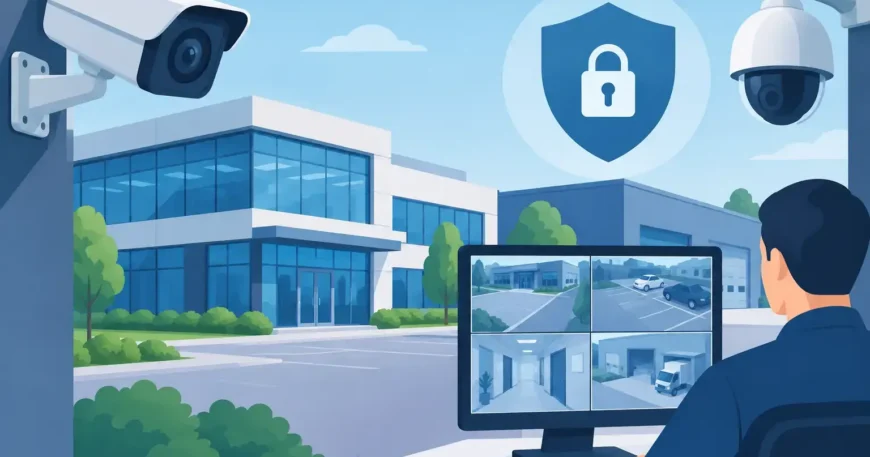
A camera system can look complete on a site plan and still miss the moment that matters. A loading dock may be covered in daylight but unusable after dark. A front entry camera may show a face but not capture enough detail for identification. An IP surveillance review is the practical process of finding those gaps before they become an incident, a complaint or an expensive reinstallation.
For offices, warehouses, apartment communities and homes, the goal is not simply to add more cameras. It is to build a surveillance system that captures usable footage, stays online, records for the required period and fits the property’s network without creating ongoing headaches.
What an IP surveillance review should assess
A proper review starts with the property, not a catalogue of camera models. The installer should walk the site, understand how people and vehicles move through it, and identify the areas where evidence, safety or operational visibility matters most.
For a commercial site, this commonly includes entrances, reception areas, cash-handling points, car parks, delivery doors, stock rooms, server rooms and external access points. In a warehouse, the priority may be dock doors, pallet storage, vehicle gates, fenced boundaries and areas where staff work alone. For multi-dwelling properties, coverage needs to balance common-area security with resident privacy, focusing on lobbies, mail areas, lifts, corridors, car parks and perimeter doors.
Camera position is only one part of the review. A dependable design also considers mounting height, lighting conditions, sun glare, blind spots, facial detail, licence plate capture, cabling routes, network capacity and recording retention. If any one of these elements is ignored, a system can appear functional while delivering poor evidence when it is needed.
Coverage is not the same as identification
One of the most common mistakes in CCTV planning is assuming that a camera pointed at an area will identify everyone in it. Wide-angle cameras are useful for general awareness, but they spread available image detail across a larger scene. They may show that someone entered a car park without clearly showing who that person was.
A review should define what each camera is expected to achieve. Is it there to detect movement at a side gate? Observe activity across a warehouse floor? Recognise a person at an entry? Read a vehicle licence plate at a gate? Those are different tasks and may require different lenses, resolutions, mounting locations and lighting.
This is where a site-specific design saves money. Installing high-resolution cameras everywhere can increase storage requirements and network traffic without improving useful coverage. Installing too few cameras, or using the same camera type in every location, can leave critical zones under-protected. The right mix depends on the risk at each point of the property.
Lighting changes the result
Poor lighting is often the real cause of poor video. Backlit glass doors, floodlights aimed towards the camera, deep shadows under awnings and dark car parks can all reduce image quality. Cameras with infrared capability help in low light, but infrared is not a cure for every problem. Reflective surfaces, vehicle headlights and long viewing distances can still affect the image.
During an IP surveillance review, it is worth checking the site at the times incidents are most likely to occur. A warehouse may look well lit at 10 am but have dark delivery areas before the first shift. An apartment entrance may be clear during the day and heavily backlit at sunset. Proper placement and practical lighting adjustments can make a greater difference than simply buying a more expensive camera.
The network must support the camera system
IP cameras are network devices. Each camera needs a reliable connection, sufficient bandwidth and power, usually through Power over Ethernet (PoE). That makes the quality of the underlying Cat5e or Cat6 cabling, switches and terminations just as important as the camera itself.
A review should establish whether the existing network can carry the additional traffic or whether surveillance should operate on its own dedicated network segment. This matters particularly in busy offices, multi-tenant buildings and properties using cloud applications, VOIP phones or wireless networks. A poorly planned camera rollout can compete with everyday business traffic, while an overloaded or ageing switch can cause cameras to drop offline.
Where cabling is exposed to weather, high traffic or industrial conditions, it also needs suitable protection and routing. Temporary leads run along walls or across access paths are not a professional long-term solution. Clean cable pathways, correctly terminated data points and properly sized PoE switching make future maintenance far easier.
For larger sites, the review should also account for fibre backbone connections between buildings, network cabinets or remote gatehouses. Copper Ethernet has distance limits. Fibre can provide the capacity and reach needed for remote cameras without compromising performance.
Storage and retention need a real plan
Footage is only useful if it can be found and played back when required. Recording capacity depends on the number of cameras, their resolution, frame rate, activity level, compression settings and whether recording is continuous or motion-based.
Many properties ask for 30, 60 or 90 days of retention without considering what that means for storage hardware. A higher-resolution camera recording around the clock requires considerably more capacity than a camera recording only when activity is detected. Motion recording can reduce storage use, but it must be configured carefully. Poor settings may miss activity at the edge of a scene or create a large number of unnecessary clips from shadows, rain or moving trees.
A review should also confirm where recordings are stored, who can access them and how they are protected. A network video recorder may suit many sites because it keeps recordings local and under the property owner’s control. Cloud storage can be useful for remote access and redundancy, but recurring costs, internet upload capacity and retention limits should be understood before committing.
Remote access should be controlled, not convenient at any cost
Owners and managers often want to check cameras from a mobile, particularly across multiple sites or after an alarm notification. That is useful, but remote viewing must be set up with security in mind. Default passwords, shared logins and unnecessary open network access are avoidable risks.
The review should identify who needs viewing rights and what level of access each person requires. A property manager may need access to common areas, while a tenant should not be able to view building-wide cameras. Managers may need playback and export permissions, while other staff only need live viewing. Clear user roles reduce confusion and help protect privacy.
It is also sensible to plan for staff turnover. Account removal, password management and documented system ownership are often overlooked until an issue arises. A professionally installed system should be manageable by the people responsible for the property, without exposing the network to shortcuts.
Use the review to plan for growth
A camera system rarely stays the same. A warehouse adds racking, an office expands into another suite, a property installs an access-control gate, or an apartment building renovates common areas. If the original installation has no spare switch capacity, cable pathways or recording headroom, every change becomes more disruptive and costly.
An effective IP surveillance review looks beyond the first installation. It identifies sensible allowance for additional cameras, network ports, PoE power and storage. That does not mean paying for unnecessary equipment upfront. It means designing the infrastructure so the next stage can be completed cleanly rather than patched together.
For property managers and developers, this is especially valuable during renovations and retrofit work. Running structured cabling while ceilings, walls or access areas are already open is usually simpler and more affordable than returning after finishes are complete.
Questions to settle before installation
Before approving an installation, the property owner or manager should be able to get clear answers to these practical questions:
- What specific area and outcome is each camera intended to cover?
- Will the system capture usable images in low light, glare and changing weather?
- Does the existing network have adequate cabling, PoE capacity and bandwidth?
- How long will footage be retained, and where will it be stored?
- Who can view, export and manage recorded footage?
- What allowance exists for future cameras, buildings or access-control integration?
If the answers are vague, the design probably needs more work. A quote should explain the equipment and installation scope in plain language, not leave the customer to guess whether network upgrades, storage or remote access are included.
Georgia Technical Services approaches surveillance as part of the wider low-voltage and network infrastructure, not as an isolated camera job. That allows camera cabling, PoE switching, network design, fibre links and future expansion to be planned as one practical solution.
The best time to review a surveillance system is before a security incident exposes its weak points. Walk the property, test the assumptions and build around the footage you would need on the worst day, not the view that looks acceptable on a quiet afternoon.
