

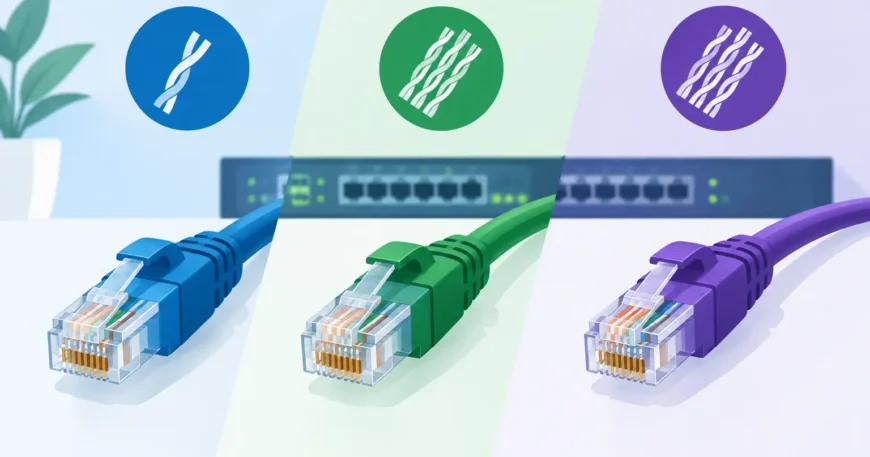
A security camera that powers up at the bench but drops offline after installation is rarely just a camera problem. Often, the cable run, conductor quality, bundle size or switch power budget is the real issue. This PoE cabling comparison explains where Cat5e, Cat6 and Cat6A fit, so the cabling behind your cameras, Wi-Fi access points, phones and smart building devices is specified properly from the start.
Power over Ethernet, or PoE, sends both data and DC power over a single twisted-pair network cable. It can reduce the need for separate power outlets at device locations, simplify upgrades and keep critical devices connected to centrally backed-up power. The result is practical, but only when the cable and network hardware are matched to the job.
What changes in a PoE cabling comparison?
The cable category matters, but it is not the only factor. A good PoE installation considers the device’s power requirement, cable distance, network speed, conductor size, heat in cable bundles and the quality of the terminations. A Cat6 label alone does not guarantee a better outcome than a correctly installed Cat5e cable.
Common PoE standards provide different amounts of power at the switch port. IEEE 802.3af, often called standard PoE, supplies up to 15.4 watts at the source. IEEE 802.3at, or PoE+, raises this to 30 watts. IEEE 802.3bt Type 3 and Type 4 are designed for higher-demand equipment and can supply up to 60 watts and 90 watts respectively at the source.
The device receives less than the power supplied by the switch because power is lost as heat along the cable. Longer runs, smaller conductors and higher loads increase that loss. This is why a low-power IP phone and a high-output PTZ camera should not be planned the same way.
The non-negotiable: solid copper conductors
For permanent in-wall, ceiling and riser cabling, use solid bare copper cable from a reputable manufacturer. Copper-clad aluminium, commonly called CCA, is cheaper but has higher resistance and poorer heat performance. It is a poor choice for structured cabling and particularly risky for PoE.
CCA may create voltage drop, intermittent device operation and excessive heat when power demand rises. It can also fail to meet recognised cabling requirements. Saving money on cable material can quickly become expensive when ceilings need to be reopened to replace it.
Cat5e for PoE: capable, with clear limits
Cat5e remains common in existing homes, offices and smaller commercial sites. It is rated for Gigabit Ethernet over the standard 100-metre channel and can support standard PoE and PoE+ when installed correctly. For fixed low-to-moderate power devices, it is often entirely serviceable.
Typical Cat5e PoE applications include IP phones, basic CCTV cameras, door stations, modest wireless access points and small network switches. If the existing cable tests correctly, is solid copper and has reasonable run lengths, replacement may not be necessary simply because a device uses PoE.
The trade-off is future capacity. Cat5e generally uses 24 AWG conductors, although construction varies by manufacturer. Its smaller conductor size and lower performance margin make it less attractive for dense bundles, longer high-power runs, multigig Wi-Fi access points or sites likely to move to 10 Gigabit networking.
Cat5e can work for higher PoE classes in some circumstances, but it requires more careful design. Cable temperature, voltage drop and device load need to be checked rather than assumed.
Cat6 for PoE: the practical default for many projects
Cat6 is often the best-value choice for new residential and commercial structured cabling. It supports Gigabit Ethernet to 100 metres and can support 10 Gigabit Ethernet over shorter distances, commonly up to 55 metres depending on installation conditions. Many Cat6 cables also use larger 23 AWG conductors, which reduces resistance compared with typical Cat5e.
That lower resistance is useful for PoE+. It can help minimise voltage drop and heat, particularly when several cables are grouped together above a ceiling, in a tray or through a riser. Cat6 is a sensible fit for modern surveillance systems, office Wi-Fi, video intercoms, access control, paging equipment and networked AV equipment.
For a new office fit-out or home renovation, Cat6 provides useful headroom without the added cost and installation difficulty of Cat6A. It is not automatically the right answer for every job, though. A warehouse with long cable pathways and high-power cameras may benefit from a higher-specification design, while a small phone-only installation may not need the extra expense.
Cat6A for PoE: built for higher capacity and growth
Cat6A is rated for 10 Gigabit Ethernet across the full 100-metre channel. It is generally larger than Cat5e or Cat6 and frequently uses 23 AWG conductors. Its improved performance and heat handling make it the strongest copper option for high-demand PoE deployments and networks expected to support faster equipment over a long service life.
Cat6A is worth serious consideration for high-density Wi-Fi, large camera deployments, high-powered PTZ cameras, LED lighting controls, digital signage, smart building systems and multi-dwelling projects. It is also a strong choice where cable bundles are large, pathways are difficult to revisit or tenants may need more bandwidth later.
The practical downside is installation. Cat6A has a larger outside diameter, requires more pathway space and needs compatible jacks, patch panels and patch leads. Poor bend radius, over-tight cable ties or incorrect termination can undermine performance. The material and labour cost is higher, so Cat6A should be selected for a clear reason rather than as a blanket upgrade.
PoE cable selection by application
For a small home CCTV system with fixed cameras and a few wireless access points, tested solid-copper Cat5e may be adequate, while Cat6 is usually the better choice for any new runs. In a typical office with PoE phones, ceiling-mounted Wi-Fi and IP cameras, Cat6 offers a practical balance of cost, performance and upgrade capacity.
For apartment buildings, high-rise retrofits, warehouses and larger commercial sites, the decision should be based on the full infrastructure plan. Cabling is difficult to replace once pathways are closed or spaces are occupied. Cat6A can make sense where runs are long, bundles are dense, Wi-Fi demand is high or a 10 Gigabit backbone to edge devices is part of the plan.
Do not overlook the switch. Every PoE switch has a total power budget, not just a per-port rating. A 24-port PoE+ switch may have enough power for only part of its ports to operate at the maximum PoE+ load. Add up the maximum expected power draw of each camera, access point and other powered device, then allow a sensible margin for growth and startup demand.
Heat, bundles and installation quality
Heat is one of the most overlooked parts of PoE design. When many powered cables are bundled tightly, each cable adds heat to the group. High ambient temperatures in roof spaces, plant rooms and warehouses can add further stress. This can reduce cable performance and affect the amount of power reaching devices.
Cable pathways should be sized for the quantity of cables and future additions, with proper support rather than improvised fixing methods. Avoid crushing cables, exceeding bend-radius limits or pulling with excessive force. Terminations should be completed to the same category as the installed cable and tested after installation.
Shielded cable is not a universal PoE upgrade. It can be helpful in electrically noisy industrial environments or where the design calls for it, but it must be installed as a complete shielded system with proper bonding and grounding. In many office, residential and standard commercial installations, quality unshielded Cat6 or Cat6A is the more straightforward choice.
Plan for the devices you will add later
The best cabling decision is usually based on what the building will need in three to 10 years, not only what is being connected this month. Ask where cameras may be added, whether Wi-Fi coverage will expand, how much bandwidth tenants or staff will require, and whether hard-to-reach areas can realistically be recabled later.
A professional site assessment can identify route constraints, cable lengths, existing infrastructure and switch requirements before installation begins. That planning is especially valuable in occupied offices, warehouses and multi-dwelling properties, where rework disrupts operations and raises costs.
Choose Cat5e when tested existing cabling genuinely suits low-power, Gigabit applications. Choose Cat6 as the practical standard for most new runs. Choose Cat6A when full-distance 10 Gigabit performance, higher-demand PoE, dense bundles or long-term expansion justify the investment. The right cable is the one that delivers dependable power and data now while leaving your property ready for the next device you need to connect.
