

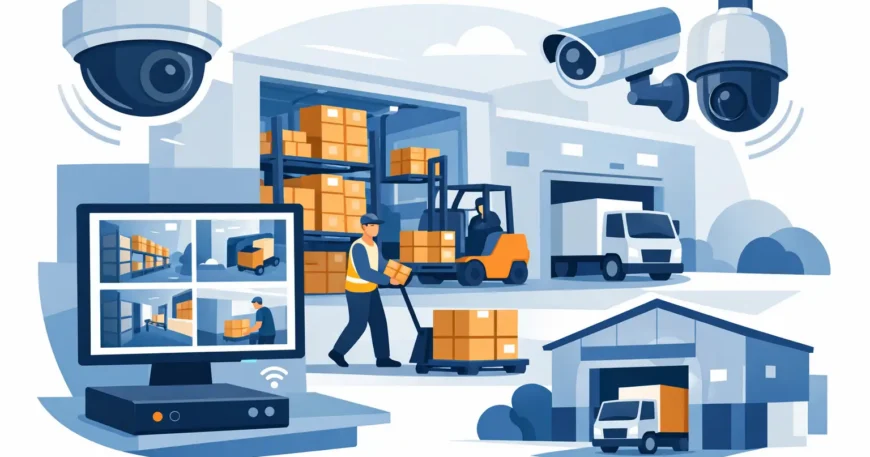
A warehouse camera system has to do more than record a person walking through a doorway. It needs to show whether a pallet was loaded onto the right truck, where stock was last handled, who entered a restricted area, and what happened during an after-hours incident. The best CCTV systems for warehouses are planned around those daily decisions, not chosen simply by camera count or the highest resolution on a box.
For warehouse operators, property managers and business owners, the right result is a dependable IP surveillance system with clear footage, sensible coverage, secure cabling and storage sized for the way the site actually operates. A poorly placed camera or an overloaded network can leave major blind spots even when the equipment itself is high quality.
Start with the risks on your site
Every warehouse has different pressure points. A smaller dispatch facility may need strong coverage of roller doors, loading bays and the stock cage. A larger distribution centre may need cameras across long aisles, picking zones, forklift routes, staff entries, plant rooms and the external perimeter.
Walk the building with the operational team before selecting equipment. Look at where stock changes hands, where drivers wait, where high-value goods are held and where incidents have happened before. Also consider the areas where a camera can improve safety investigations, such as pedestrian crossings, battery charging stations and busy intersections between forklifts and staff.
This process usually shows that more cameras are not automatically better. What matters is placing the right camera at the correct height and angle, with enough detail to identify activity. A wide view of a loading dock is useful for situational awareness, but it may not capture a face or number plate clearly from the far side of the yard. That location may need a second, tighter camera.
Best CCTV systems for warehouses use IP cameras
For most new installations, IP CCTV is the practical choice. IP cameras send digital video across the data network, commonly using Power over Ethernet. One Cat6 cable can provide both network connectivity and power to the camera, reducing the need for separate electrical outlets at every mounting point.
This approach suits warehouses because systems can scale as the site grows. Cameras can be added when new racking, dispatch lanes or tenancy areas are introduced, provided the network and recording platform are designed with capacity in mind. Remote viewing is also easier to manage, allowing authorised managers to check live views or recorded footage from a computer or mobile device.
A professional installation should separate surveillance traffic from ordinary business traffic where appropriate. Cameras generating continuous high-resolution video can consume significant bandwidth. A dedicated network switch, suitable uplinks and correctly configured VLANs help prevent CCTV from affecting office internet access, warehouse scanners, VOIP phones or other critical systems.
Fixed turret and dome cameras for internal coverage
Fixed turret or dome cameras are often the workhorses inside a warehouse. They suit entrances, packing benches, dispatch counters, aisle ends and internal doors. A turret design can make aiming simpler, while vandal-resistant dome cameras can be a good option in accessible areas where equipment could be knocked or interfered with.
Resolution matters, but only when matched to the scene. A 4MP or 5MP camera often provides excellent detail for normal internal coverage. Higher-resolution cameras can be worthwhile for wide areas, but they also increase storage and network requirements. The aim is usable evidence, not oversized files that are costly to retain.
Bullet cameras for yards and loading bays
Bullet cameras are commonly used for external walls, driveway approaches, roller doors and loading docks. Their visible form can act as a deterrent, and their housing is well suited to outdoor mounting. Choose weather-rated equipment designed to handle dust, rain, heat and changing light conditions.
For external areas, look closely at night performance. Infrared illumination can help in darkness, but reflective surfaces, truck headlights and security lighting can all affect the image. Cameras with good low-light sensors and wide dynamic range are useful where bright loading bays meet dark yards or where vehicles regularly enter the frame.
PTZ cameras for large open areas
Pan-tilt-zoom cameras can cover broad yards or large internal spaces and let an operator zoom in on a developing event. They are valuable at sites with active security monitoring, gatehouses or frequent vehicle movement.
They should not be the only camera protecting a critical area. A PTZ points in one direction at a time, which means it can miss activity elsewhere while tracking a vehicle or person. Fixed cameras provide continuous evidence, while a PTZ adds flexible oversight where it genuinely helps.
Number plate and specialised cameras
If vehicles entering or leaving the property are a concern, a dedicated number plate recognition camera may be a better choice than an ordinary overview camera. It needs to be positioned for the expected travel direction, speed, lighting and distance. Trying to read plates from a general-purpose yard camera often produces disappointing results.
Thermal cameras, fisheye cameras and video analytics can also have a place in larger or higher-risk facilities. Thermal imaging can assist with perimeter detection in poor light, while analytics may flag line crossing, loitering or objects left in restricted zones. These features need careful configuration and testing. Alerts that trigger constantly soon get ignored.
Coverage, lighting and mounting make the difference
A camera plan should show what each device is intended to capture. For a personnel entrance, that may be a clear head-and-shoulders image. For an aisle, it may be activity at both ends and visibility over stock movement. For a loading bay, it may be the trailer door, pallet transfer area and the surrounding approach.
Mounting height is a frequent compromise. Cameras installed too high offer a broad view but can make identification difficult. Cameras positioned too low are easier to tamper with or block. Racking, high-bay lights, sprinklers and steelwork also influence sightlines. A site survey prevents cameras being mounted neatly but pointed at an obstruction.
Good lighting supports better footage. Security lighting should illuminate access paths, yards and doors without shining directly into the lens. In internal aisles, check image quality with the warehouse lights in their normal operating state. Shadows from high racking and bright skylights can be more challenging than they first appear.
Plan recording capacity before installation
The recorder is the evidence store for the system. Network video recorders, or NVRs, are usually the right option for IP camera installations. They should have enough processing capacity, network throughput and hard drive space for the chosen camera count, resolution, frame rate and retention period.
Retention is not a fixed number. Some sites only need 14 to 30 days of footage, while others require longer periods because of stock disputes, insurance obligations or long dispatch cycles. Recording continuously gives the fullest record but uses more storage. Motion recording can reduce storage use in quiet areas, although warehouse activity, moving lights and dust may create unwanted recordings if settings are not tuned correctly.
Use surveillance-grade hard drives and protect the recorder from unauthorised access. The NVR should be installed in a locked communications cabinet or secure server room, supported by an uninterruptible power supply where practical. A power interruption should not be allowed to erase footage or leave the site unprotected during a restart.
Choose an installer who understands cabling and networks
Warehouse CCTV is not just a camera job. It is a low-voltage cabling, power, network and mounting project that needs to work as one system. Cables may need to run through high ceilings, cable tray, conduit, warehouse offices and external pathways. They must be labelled, terminated correctly and protected from damage, forklifts and environmental exposure.
A clean Cat6 installation gives the system a reliable foundation and makes future changes easier. Fibre backbone links can be the right answer where cameras are spread across separate buildings, large yards or distant gatehouses. Wireless links may be appropriate in limited situations, but they should be selected carefully because distance, obstructions and radio interference can affect performance.
Georgia Technical Services approaches warehouse surveillance as part of the wider site infrastructure. That means considering the camera layout alongside network switches, structured cabling, server room equipment, access control and future expansion, rather than treating CCTV as a standalone add-on.
Questions to ask before approving a system
Ask the installer to explain what each camera is expected to capture and whether it can identify a person, monitor activity or read a number plate at that distance. Confirm how long footage will be retained, who can access it remotely and how the system is protected from power loss or network failure.
You should also ask about after-hours support, warranty arrangements, camera maintenance and the process for adding devices later. Warehouses change quickly. New racking layouts, altered dispatch routes and additional tenants can all create coverage gaps that were not present on day one.
The best system is one your team can use under pressure. Clear live views, straightforward footage search, properly labelled cameras and professional support matter just as much as the specifications. Plan the system around the work happening on the floor, and it will remain useful long after installation day.

