

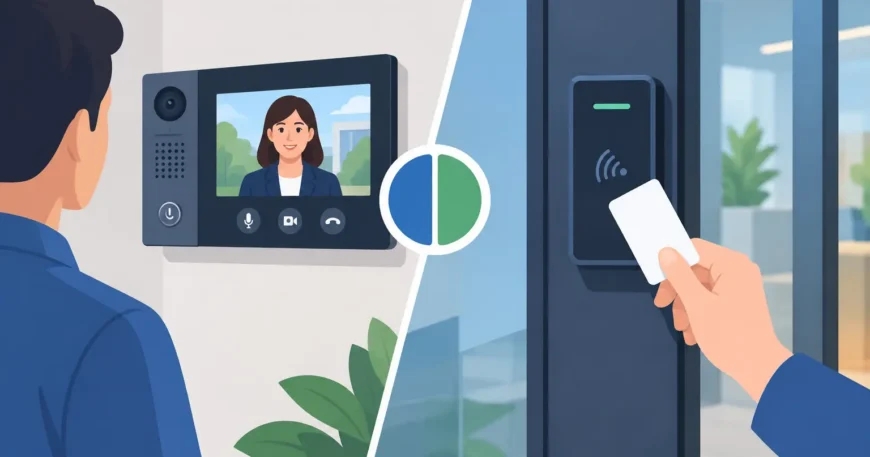
A locked front door does not tell you who is standing outside. A video intercom can show you, but it may not control every door, user or access schedule across a property. That practical difference is at the centre of intercom vs access control systems. Both improve entry security, but they solve different problems and are often most effective when planned together.
For a home, office, warehouse or apartment building, the right choice depends on how people enter, who needs authority to grant access, and what level of record keeping is required. The goal is not to add technology for its own sake. It is to install a dependable entry system that suits the way the property operates.
What an intercom system does
An intercom is primarily a communication system at an entry point. A visitor presses a call button, selects a tenant, unit or reception point, and speaks with someone inside. Depending on the equipment, the person receiving the call can hear audio, view live video, speak to the visitor and release the door or gate remotely.
For a single home, this may be a door station connected to an internal monitor or mobile app. For an office, it might call reception before staff release the front door. In a multi-dwelling building, visitors can call individual units from a panel at the main entrance.
Intercoms answer a simple but valuable question: who is requesting entry? They are especially useful where guests, couriers, contractors and customers arrive regularly. A warehouse office with drivers at a secured gate, for example, needs a quick way to verify a visitor without sending staff across the site.
The limitation is that a basic intercom is not designed to manage regular users in detail. It may release a lock, but it does not necessarily issue staff credentials, remove access when an employee leaves, or provide a reliable report of every door event. Those are access control functions.
What an access control system does
Access control manages who can enter a door, gate, lift level or restricted area, and when they can do so. Instead of calling someone, an authorised user presents a card, fob, PIN, mobile credential or biometric identifier. If their permissions are valid, the system releases the locking hardware.
A properly configured system can give different people different permissions. Office staff may access the front entry during business hours, managers may have after-hours access, and authorised technicians may only enter a plant room on scheduled days. In an apartment property, access control can restrict entry to common areas while allowing residents to use their own credentials.
The system can also create an audit trail. Property managers and business owners can review door activity, investigate an incident or confirm whether a restricted door was accessed at a particular time. This is a major reason access control is preferred for workplaces, larger facilities and shared buildings.
Access control does need careful planning. Readers, electric strikes or magnetic locks, door contacts, request-to-exit devices, cabling, power supplies and backup arrangements all need to work as one system. A card reader on the wall is only the visible part of the installation.
Intercom vs access control systems: the practical difference
The easiest way to separate the two is to think about visitors and regular users. An intercom handles visitor communication. Access control handles authorised entry for known users.
An intercom lets a resident or receptionist decide whether to let someone in at that moment. Access control lets the system make that decision automatically according to permissions already set up. One is centred on screening and conversation; the other is centred on controlled, repeatable access.
There is overlap. Many modern video intercoms can release a door lock, and some access control platforms include video calling or camera integration. That does not mean they are interchangeable. A video door station may be ideal for a small office with a single secure entrance. It may be inadequate for a business with 40 staff, multiple doors, changing rosters and compliance requirements.
Likewise, a card access system at an apartment entrance may keep unauthorised people out, but residents still need a convenient way to speak with visitors and grant entry to family, delivery drivers or tradespeople. In that setting, an integrated intercom and access control design usually makes more sense than choosing one over the other.
When an intercom is the better fit
An intercom is often the right starting point when the main concern is identifying visitors before allowing them inside. Homes, small professional offices, gated driveways and small retail premises commonly benefit from this approach.
Video capability is worth considering where staff cannot see the entry from their usual position, or where the property has frequent deliveries. It gives the person inside more information before they press the release button. For residential installations, a system that supports internal screens and mobile notifications can be convenient, provided the property has suitable network coverage and reliable power.
Choose an intercom-first solution when there are few doors, a limited number of regular users and no real need for detailed access reports. It keeps the system straightforward and can control installation costs without sacrificing basic visitor security.
When access control is the better fit
Access control becomes the stronger choice when a property needs consistency, accountability and the ability to manage many users. Offices, medical rooms, warehouses, schools, strata common areas and commercial sites with staff turnover are typical examples.
It is particularly useful where keys have become a problem. Physical keys can be copied, lost or retained after a worker or tenant leaves. With electronic access control, a credential can be disabled quickly without rekeying every lock. New permissions can be assigned without cutting and distributing another set of keys.
For warehouses and industrial sites, access control can separate public-facing areas from stock, loading zones, server rooms and staff-only spaces. For property managers, it can reduce the ongoing headache of managing keys across shared facilities. The exact benefit depends on the software, hardware and how permissions are maintained, but the operational advantage is clear when more than a handful of people require access.
Why integrated systems are often the sensible choice
For many commercial and multi-dwelling properties, the best answer is not intercom or access control. It is both, connected to suitable door hardware, structured cabling and network infrastructure.
At a main entrance, a visitor can call reception or a resident through the intercom. Employees or residents can use their credential to enter without making a call. At restricted internal doors, access control can manage authorised entry. CCTV can provide a visual record of activity around key entrances, while the access system records the credential event.
This approach is useful because each part does its proper job. The intercom handles communication. Access control handles permissions. Surveillance supports verification and incident review. Trying to force one device to cover every requirement can lead to awkward operation and expensive changes later.
Integration should be planned before walls are closed or finishes are completed. Low-voltage cabling routes, network switches, lock power, door frames and fire safety requirements all affect the final result. Retrofitting is possible, but early planning generally provides a cleaner installation and more options.
Questions to ask before choosing a system
Start with the property’s daily traffic. How many doors need to be controlled? Are visitors expected regularly? Will people need entry after hours? Does the site need to know who entered a particular area and when?
Then consider the property’s future, not just its current layout. A small office may add staff. An apartment building may need unit-by-unit visitor calling. A warehouse may introduce restricted stock areas. Selecting equipment that can be expanded is often more cost-effective than replacing a basic system once operational needs change.
Also check the condition of existing infrastructure. Older buildings may have unsuitable cabling, inconsistent power supply arrangements or door hardware that is not compatible with electronic release. A site assessment can identify whether existing wiring can be reused and where upgrades are needed. This is especially valuable in retrofit projects, where a practical installation plan avoids unnecessary disruption to tenants and operations.
Finally, do not overlook reliability during outages. Electronic locks, network equipment and intercom panels need the right power design, and doors must operate safely in line with their purpose and applicable requirements. The correct fail-safe or fail-secure arrangement is not a minor detail. It affects both security and safe exit from the building.
Plan the entry system around the way the property works
The right entry solution should make life easier for residents, staff and managers while giving visitors a clear, professional point of contact. If the priority is screening people at the door, start with an intercom. If the priority is managing authorised users across one or more doors, access control is the stronger foundation. Where a property needs both, a coordinated installation delivers far better results than separate systems added over time.
A practical assessment of doors, cabling, users and daily access patterns will identify the right mix before installation begins. That is the point where a well-planned low-voltage system stops being another maintenance issue and starts supporting the property properly.
